
Backlog
Project backlog tools and sidebar for OpenCode 2
3
+2 in 30 days
152
38 in 7 days
41.7
Multi-signal model
7 days ago
2026-09-28
Install and configure
opencode.jsonWrites to this project's opencode.json — applies to this repository only.
opencode.json
{
  "$schema": "https://opencode.ai/config.json",
  "plugin": ["opencode-backlog@0.2.3"]
}
Writes to ~/.config/opencode/opencode.json — applies to every project.
~/.config/opencode/opencode.json
{
  "$schema": "https://opencode.ai/config.json",
  "plugin": ["opencode-backlog@0.2.3"]
}
If you want to modify the plugin locally, install it into the project and reference the local path.
shell
pnpm add -D opencode-backlogOpenCode loads npm dependencies through its embedded runtime on startup and caches them locally — no manual global install needed.
A persistent project backlog for OpenCode V2 agents and the TUI.
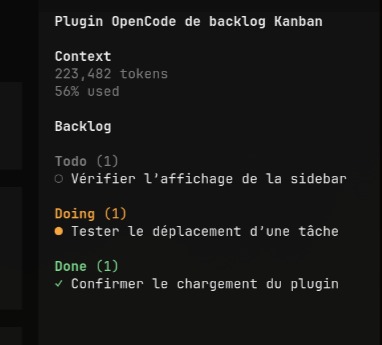
opencode-backlog gives the agent tools to manage project tasks. It also adds an interactive backlog to the OpenCode sidebar and command palette.
Published package: opencode-backlog on npm.
What It Does
The plugin stores tasks and ordered categories in BACKLOG.json at the project root.
New backlogs contain these categories:
tododoingdone
You can add, rename, style, reorder, purge, and remove categories. Each category has a stable ID and a modifiable title.
The server plugin manages tasks and categories. The TUI plugin provides:
- A live backlog summary below the sidebar context.
- A
Browse backlogcommand in the command palette. /backlogand/tasksslash commands.- Task details and category changes from the TUI.
/backlog-purgeto remove every task from a selected category./backlog-categoriesto manage categories.
Requirements
- OpenCode V2 with the beta plugin API.
- Node.js 24 and npm, or Nix with flakes enabled.
The Nix development shell supplies Node.js 24 and npm when you use Nix.
The plugin currently targets @opencode-ai/plugin@0.0.0-beta-17927.
Install With Node.js
Clone the repository and build the plugin:
git clone https://github.com/sachahjkl/opencode-backlog.git
cd opencode-backlog
npm ci
npm run build
pwd
Add the server entrypoint to opencode.jsonc. Replace /absolute/path/to/opencode-backlog with the path printed by pwd.
{
  "$schema": "https://opencode.ai/config.json",
  "plugins": [
    "/absolute/path/to/opencode-backlog/dist/index.js"
  ]
}
Add the TUI entrypoint to ~/.config/opencode/cli.json:
{
  "plugins": [
    "/absolute/path/to/opencode-backlog/dist/tui.js"
  ]
}
Restart the OpenCode service and reopen the TUI:
opencode2 service restart
Install With Nix
Build the package:
nix build github:sachahjkl/opencode-backlog
realpath result
The result contains two plugin entrypoints:
result/lib/opencode-backlog/dist/index.js
result/lib/opencode-backlog/dist/tui.js
Add the server entrypoint to opencode.jsonc. Replace /nix/store/... with the path printed by realpath result.
{
  "$schema": "https://opencode.ai/config.json",
  "plugins": [
    "/nix/store/...-opencode-backlog-0.1.0/lib/opencode-backlog/dist/index.js"
  ]
}
Add the TUI entrypoint to ~/.config/opencode/cli.json:
{
  "plugins": [
    "/nix/store/...-opencode-backlog-0.1.0/lib/opencode-backlog/dist/tui.js"
  ]
}
Restart the OpenCode service after the first installation:
opencode2 service restart
Reopen the TUI to load the TUI plugin.
Use The Backlog
Ask the agent to manage tasks in normal language:
Add a Todo task to document the release process.
Add a Blocked category after Doing.
Move the release task to Blocked.
Purge all tasks in Done.
Open the command palette and select Browse backlog to inspect tasks. Select a task to view its ID, notes, and category.
Run /backlog or /tasks to open the same browser directly.
The backlog browser provides these shortcuts:
Enteropens the selected task details.ncreates a task.cchanges the selected task category.eedits the selected task.ddeletes the selected task after confirmation.ppurges all tasks from a selected category after confirmation.
Click a sidebar task to open its details. The detail dialog provides c, e, and d for the same actions.
Agent Tools
| Tool | Purpose |
|---|---|
backlog_list |
List tasks with optional category and query filters. |
backlog_add |
Add a task at an optional category and position. |
backlog_update |
Change a task title or notes. |
backlog_move |
Change a task category or position. |
backlog_remove |
Permanently remove a task. |
backlog_category_add |
Add a category with a stable ID, title, color, and icon. |
backlog_category_update |
Change a category title, color, or icon. |
backlog_category_move |
Change a category position. |
backlog_category_remove |
Remove an empty category. |
backlog_category_purge |
Permanently remove all tasks from a category. |
The agent receives task IDs from backlog_list and from each mutation result.
Backlog File
The plugin creates BACKLOG.json when the first task or category is added:
{
  "version": 2,
  "categories": [
    { "id": "todo", "title": "Todo", "color": "subdued", "icon": "circle" },
    { "id": "doing", "title": "Doing", "color": "warning", "icon": "dot" },
    { "id": "blocked", "title": "Blocked", "color": "error", "icon": "cross" },
    { "id": "done", "title": "Done", "color": "success", "icon": "check" }
  ],
  "items": [
    {
      "id": "c50437e3-2a57-424d-9257-32ec432145a9",
      "title": "Add invoice search",
      "notes": "Search by customer name and invoice number.",
      "status": "doing"
    }
  ]
}
The category array defines category order. The item array defines task order inside each category.
Category IDs stay stable when titles change. The plugin rejects tasks that reference an unknown category ID.
Category colors use theme-aware values: default, subdued, error, warning, success, or info.
Category icons use circle, dot, check, cross, pause, diamond, or none.
Known category IDs provide style presets when color or icon is absent:
| ID | Color | Icon |
|---|---|---|
todo |
subdued |
circle |
doing |
warning |
dot |
blocked |
error |
cross |
review |
info |
diamond |
waiting |
warning |
pause |
done |
success |
check |
cancelled |
subdued |
cross |
The plugin reads version 1 files with the default categories. The next backlog change writes the file as version 2.
Commit BACKLOG.json when the backlog must follow the project. Ignore it when the backlog must remain local.
Verify The Installation
List active server plugins:
opencode2 api get /api/plugin
The response must include opencode.backlog.
Open the command palette in the TUI. The Browse backlog command confirms that the TUI entrypoint loaded.
Development
Run all development commands through Nix:
nix develop
nix develop -c pre-commit run --all-files
nix develop -c npm run check
nix develop -c npm test
nix flake check --print-build-logs
Entering nix develop installs the repository pre-commit hook. The hook checks Nix formatting, GitHub Actions, JSON, merge conflicts, file sizes, and whitespace.
BACKLOG.json is not required by the test suite.
Release
Publish each release from an authenticated workstation:
npm login
npm publish
Update the package version, then push its commit and tag:
npm version patch
git push origin master --follow-tags
Use minor or major instead of patch when the release requires it. Keep the tag equal to the package.json version.
Compatibility
This project targets OpenCode V2. The V2 plugin API is beta and can change between OpenCode releases.
Match the plugin API version in package.json with the OpenCode release that loads the plugin.
Similar plugins

With Claude
opencode-with-claude
OpenCode plugin to use your Claude Max subscription via Meridian proxy

Goal
opencode-goal-plugin
Durable, guarded goal workflows for OpenCode.

Openai Compact
opencode-openai-compact
OpenCode plugin that stores OpenAI Responses API compaction checkpoints in SQLite.