
Openai Compact
OpenCode plugin that stores OpenAI Responses API compaction checkpoints in SQLite.
40
+9 in 30 days
2,783
550 in 7 days
60.2
Multi-signal model
1 day ago
2026-10-04
Install and configure
opencode.jsonWrites to this project's opencode.json — applies to this repository only.
opencode.json
{
  "$schema": "https://opencode.ai/config.json",
  "plugin": ["opencode-openai-compact@1.4.0"]
}
Writes to ~/.config/opencode/opencode.json — applies to every project.
~/.config/opencode/opencode.json
{
  "$schema": "https://opencode.ai/config.json",
  "plugin": ["opencode-openai-compact@1.4.0"]
}
If you want to modify the plugin locally, install it into the project and reference the local path.
shell
pnpm add -D opencode-openai-compactOpenCode loads npm dependencies through its embedded runtime on startup and caches them locally — no manual global install needed.


Use OpenAI's official Responses API compaction v2 in OpenCode.
OpenCode can compact long coding sessions. When you are using OpenAI Responses models, this plugin sends a normal /responses request whose final input item is compaction_trigger, instead of asking another model to write a text summary.
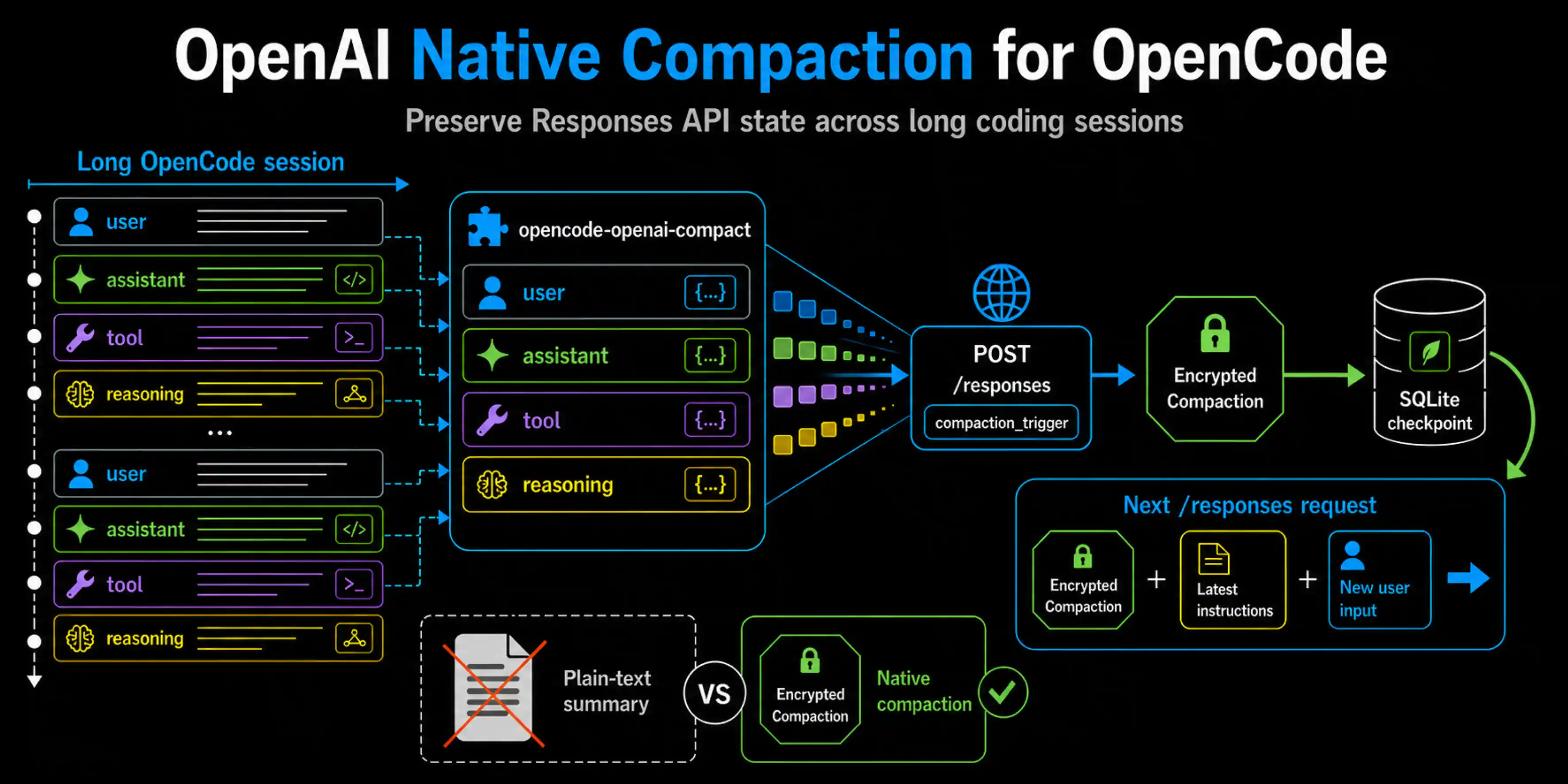
Why Native Compaction
| Default prompt summary | OpenAI native compaction |
|---|---|
| Generates a plain text summary | Returns an encrypted compaction item |
| Can miss tool or reasoning state | Built for the Responses API state model |
| App-owned summary format | Official Responses compaction output |
| You decide what to keep | OpenAI returns the next compacted window |
The important part is simple: compaction v2 returns an encrypted compaction item that should be passed to the next /responses request. This plugin makes OpenCode do that for OpenAI providers.
What It Does
- Intercepts OpenCode session compaction for configured OpenAI providers.
- Sends the current Responses input window to
/responseswith a finalcompaction_triggeritem. - Removes OpenCode's internal summary prompt from the compact request body.
- Stores the compacted output in a local SQLite checkpoint.
- Injects that checkpoint into the next
/responsesrequest for the same session. - Replaces OpenCode's synthetic post-compaction exchange with the active checkpoint while preserving later real messages.
When To Use It
Use this if:
- You use OpenAI Responses API models in OpenCode.
- You run long coding sessions that hit compaction.
- You want OpenAI's official compaction item instead of a custom text summary.
Skip it if:
- You do not use OpenAI Responses API providers.
- You prefer OpenCode's default prompt-based summary.
- Your sessions are short enough that compaction does not matter.
Install
Add the npm package to your OpenCode config.
{
  "$schema": "https://opencode.ai/config.json",
  "plugin": ["opencode-openai-compact"]
}
For a local checkout during development, use a file URL.
{
  "$schema": "https://opencode.ai/config.json",
  "plugin": ["file:///path/to/opencode-openai-compact"]
}
Requirements:
| Runtime | Version |
|---|---|
| Node.js | >=22.12.0 |
| OpenCode | >=1.18.7 (Tested with 1.18.23) |
Configuration Files
Most users do not need plugin-specific configuration.
Create openai-compact.json or openai-compact.jsonc only when you want to override defaults. Later layers override earlier layers. Within the same directory, openai-compact.jsonc is read after openai-compact.json and can override it.
Read order:
- Built-in defaults.
- Global OpenCode config directory:
openai-compact.json, thenopenai-compact.jsonc. - Directory from
OPENCODE_CONFIG_DIR:openai-compact.json, thenopenai-compact.jsonc. - Nearest project
.opencodedirectory found by walking upward from the current directory:openai-compact.json, thenopenai-compact.jsonc.
Exception: state.retentionDays is read only from layer 2 because all projects share one global database. Values in layers 3 and 4 are ignored with a warning.
Global OpenCode config directory:
$XDG_CONFIG_HOME/opencode, whenXDG_CONFIG_HOMEis set.~/.config/opencode, whenXDG_CONFIG_HOMEis not set.
If neither openai-compact.json nor openai-compact.jsonc exists in the global OpenCode config directory, the plugin creates an empty openai-compact.jsonc file on first load.
State Database
Runtime checkpoints are stored in SQLite at:
~/.config/opencode/openai-compact/checkpoints.db
The database stores checkpoints and the message IDs of OpenCode's internal post-compaction control turns. Tracking IDs keeps those turns out of future requests even if OpenCode changes their text, metadata, or position.
When a forked OpenCode session first runs after compaction, checkpoints and control turns before the fork point are copied to the new session with their regenerated message IDs.
The default retention is 30 days. Retention is a global maintenance policy for this shared database, not a per-project setting. Set state.retentionDays only in the fixed global OpenCode config directory. Values from OPENCODE_CONFIG_DIR or project .opencode files are ignored with a warning so one project cannot prune another project's checkpoints.
Example Configuration
{
  "$schema": "https://raw.githubusercontent.com/partment/opencode-openai-compact/main/configSchema.json",
  "enabled": true,
  "providers": {
    "openai": {
      "enabled": true,
      "compactModel": null,
      "compactReasoningEffort": null
    }
  },
  "headers": {
    "compact": "x-opencode-openai-responses-compact",
    "session": "x-opencode-openai-responses-compact-session"
  },
  "responses": {
    "endpointPath": "/responses"
  },
  "compactBodyKeys": [
    "input",
    "instructions",
    "tools",
    "parallel_tool_calls",
    "reasoning",
    "service_tier",
    "prompt_cache_key",
    "text"
  ],
  "summary": "Context compacted.\nFollowing conversations will continue from this compacted checkpoint.",
  "state": {
    "retentionDays": 30,
    "deleteOnSessionDeleted": true
  }
}
Configuration Reference
| Field | Type | Default | Description |
|---|---|---|---|
enabled |
boolean |
true |
Enables or disables the plugin. |
providers |
object |
{ "openai": { "enabled": true, "compactModel": null, "compactReasoningEffort": null } } |
Provider ids to wrap, keyed by OpenCode provider id. Each provider can be explicitly enabled or disabled. |
headers |
object |
see below | Internal header names. |
responses |
object |
see below | Responses endpoint path settings. |
compactBodyKeys |
string[] |
see example | Request body keys copied into compact calls. |
summary |
string |
see example | Synthetic assistant text emitted after compaction. |
state |
object |
see below | SQLite retention and delete behavior. |
headers
| Field | Type | Default | Description |
|---|---|---|---|
compact |
string |
"x-opencode-openai-responses-compact" |
Internal header that marks a compaction request. Header names are normalized to lowercase and must be valid token names. |
session |
string |
"x-opencode-openai-responses-compact-session" |
Internal header that carries the OpenCode session id. It must differ from compact and cannot use reserved authentication, content, connection, or routing names. |
providers
| Field | Type | Default | Description |
|---|---|---|---|
providers.<id>.enabled |
boolean |
true |
Enables or disables compaction wrapping for this provider. Set providers.openai.enabled to false to leave the built-in OpenAI provider untouched. |
providers.<id>.compactModel |
string | null |
null |
Model sent to the /responses compaction v2 request. null follows the model used by the latest conversation part for both automatic and manual compaction. |
providers.<id>.compactReasoningEffort |
"none" | "minimal" | "low" | "medium" | "high" | "xhigh" | "max" | null |
null |
Reasoning effort sent to compaction. null follows the current conversation selection. Supported levels vary by model. |
Priority: explicit setting > latest conversation part > OpenCode's original compaction request.
null uses the next available value in that order.
Provider settings are deep-merged across configuration layers. Adding a custom provider does not remove the default openai entry. To use only a custom provider:
{
  "providers": {
    "openai": { "enabled": false },
    "custom-openai": { "enabled": true }
  }
}
responses
| Field | Type | Default | Description |
|---|---|---|---|
endpointPath |
string |
"/responses" |
Responses API path suffix to intercept. Whitespace-only values and / are rejected; values are trimmed, prefixed with /, and stripped of trailing slashes. |
compactEndpointPath |
string |
"/responses/compact" |
Deprecated and ignored. Retained only so existing configuration files continue to load. |
state
| Field | Type | Default | Description |
|---|---|---|---|
retentionDays |
integer |
30 |
Global number of days to keep checkpoints in the shared database. Only the fixed global config directory may override it; non-global values are ignored with a warning. |
deleteOnSessionDeleted |
boolean |
true |
Deletes stored rows on session.deleted. When false, rows remain but are tombstoned and never used again. |
Configuration diagnostics
Set OPENCODE_OPENAI_COMPACT_DEBUG=1 to print an effective-configuration summary at startup. The summary includes existing configuration files, fields overridden by each layer, enabled providers, endpoint and header settings, the shared database path, the global retention scope, ignored retention overrides, and deprecated fields. It does not print authentication tokens.
Unknown fields in nested objects are rejected instead of silently ignored. JSONC syntax errors include the source file, line, column, and parser error.
Star Us On GitHub
Development
pnpm install
pnpm run typecheck
pnpm run test
pnpm run build
Similar plugins

Better Compact
better-compact
OpenCode plugin that improves long-session context with boundary-time pruning

Compaction Guard
opencode-compaction-guard
OpenCode plugin that prevents and auto-recovers from the 'tool_use ids were found without tool_result blocks' error that makes sessions unrecoverable after auto-compaction or interrupted tool calls.

Openai Codex Headers
opencode-openai-codex-headers
Stopgap opencode plugin that smooths the OpenAI/Codex GPT-5.6 rough edges (Luna 404s, missing session titles, reasoning-summary markers) until native support lands