
0
0
20.0
生态多维模型
10 小时前
2026-09-12
快速安装与配置
opencode.json写入当前项目的 opencode.json,只对这个仓库生效。
opencode.json
{
  "$schema": "https://opencode.ai/config.json",
  "plugin": ["opencode-usage-panel@0.1.1"]
}
写入 ~/.config/opencode/opencode.json,对所有项目生效。
~/.config/opencode/opencode.json
{
  "$schema": "https://opencode.ai/config.json",
  "plugin": ["opencode-usage-panel@0.1.1"]
}
若你要在本地改造这个插件,先装到项目里再从本地路径引用。
shell
pnpm add -D opencode-usage-panelOpenCode 启动时会通过内嵌运行时自动加载 npm 依赖并缓存至本地目录,无需手动在全局环境执行安装。

A sidebar panel for the opencode TUI that breaks a session down by model: how many tokens each one consumed and what it cost.
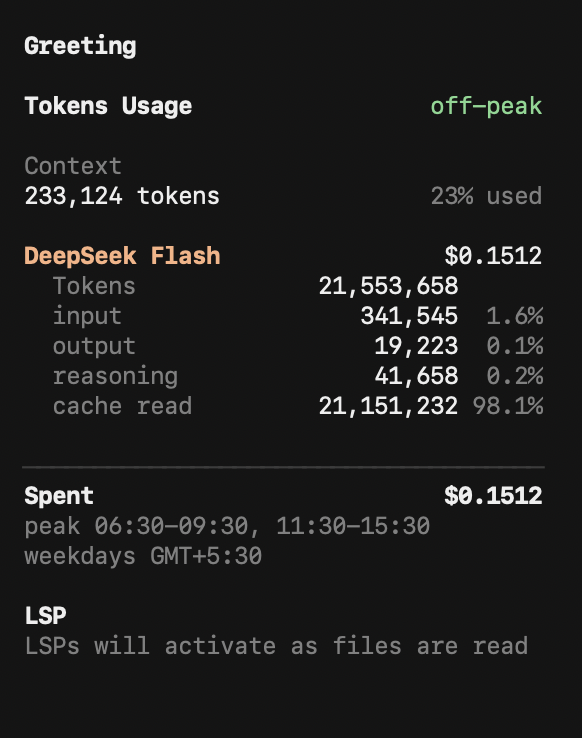
The Context block mirrors opencode's built-in panel — the token count and
share of the context window for the latest assistant turn — but leaves out its
cost, which does not account for peak pricing.
Each model gets a header row with its estimated cost, then the input
(cache miss), output, reasoning, and cache read (cache hit) counters
summed over the session. The percentage on each row is that counter's share of
the model's own total tokens.
Requirements
- opencode
>= 1.18.0
The plugin is a TUI plugin: it imports from @opencode-ai/plugin/tui and renders
into the sidebar_content slot at order 100, the same slot the built-in
context panel uses.
Install
From npm
Available on npm: opencode-usage-panel.
Install it with the CLI:
opencode plugin opencode-usage-panel --global
Or add the package to tui.json yourself — opencode installs npm plugins on
startup. Use .opencode/tui.json (project) or ~/.config/opencode/tui.json
(global):
{
  "$schema": "https://opencode.ai/tui.json",
  "plugin": ["opencode-usage-panel"]
}
From a local checkout
There's no need to copy the file into a plugin directory. Point tui.json
straight at the source with an absolute path (or a file:// URL):
{
  "$schema": "https://opencode.ai/tui.json",
  "plugin": ["/Users/you/opencode-usage-panel/src/index.tsx"]
}
Disable the built-in panel
The plugin renders into the same slot as opencode's built-in context panel, so turn that one off to avoid stacking:
{
  "plugin_enabled": {
    "internal:sidebar-context": false
  }
}
Pricing
Cost is computed per message from a rate table, so peak/off-peak pricing is
honoured using each message's own timestamp. Models without a configured rate
table fall back to the cost opencode records, which is priced automatically
from models.dev (free tiers show —).
Rate tables
Prices are US dollars per million tokens. input is cache-miss input,
cacheRead is cache-hit input, and output also covers reasoning unless a
separate reasoning rate is given.
{
  "plugin": [
    [
      "opencode-usage-panel",
      {
        "pricing": {
          "deepseek-flash": {
            "input": 0.15,
            "output": 0.6,
            "cacheRead": 0.003,
            "peak": {
              "input": 0.3,
              "output": 1.2,
              "cacheRead": 0.006
            }
          }
        }
      }
    ]
  ]
}
Keys can be a bare modelID or providerID/modelID. Top-level rates apply
outside peak windows; the optional peak block replaces them inside peak
windows. A model without peak has flat pricing.
Peak windows
peakHours is always specified in UTC, since that is how providers publish
their schedules. Windows may wrap past midnight, and days restricts them to
UTC weekdays (mon..sun, JS-style 0..6 also accepted; omit for every
day). DeepSeek's schedule — weekdays 01:00-04:00 and 06:00-10:00 UTC — is:
{
  "peakHours": [
    { "start": "01:00", "end": "04:00", "days": ["mon", "tue", "wed", "thu", "fri"] },
    { "start": "06:00", "end": "10:00", "days": ["mon", "tue", "wed", "thu", "fri"] }
  ]
}
Messages are matched against these windows in UTC, so the result is correct
whatever your machine's timezone is. For display, times are converted to your
local timezone by default (IST for Asia/Kolkata); set "timezone": "utc" to
render them in UTC instead.
The extra cost paid for peak messages is shown under Spent. While a peak
window is active the panel shows a ▲ peak badge next to affected models and
the time the window ends; otherwise it lists the configured peak windows.
License
MIT — see LICENSE.
同类生态推荐

Context Usage
opencode-context-usage
OpenCode TUI plugin: a /context command with the exact token breakdown behind the built-in Context panel (last request) plus session-wide usage, subagent totals, cache hit rate and cost.

Thinking Meter
opencode-thinking-meter
OpenCode TUI plugin: counts the turns cut off mid-thought, says whether the output cap or the context window did it, and shows what thinking costs per turn and after which tool.

Usage Monitor
opencode-usage-monitor
OpenCode TUI sidebar plugin that displays API usage quotas for OpenAI and Z.AI (GLM) providers