
Claudeway
Use your Claude Pro/Max subscription in OpenCode V2 via Claude Code credentials, no API key
1
0
22.4
Multi-signal model
15 hours ago
2026-10-20
Install and configure
opencode.jsonWrites to this project's opencode.json — applies to this repository only.
opencode.json
{
  "$schema": "https://opencode.ai/config.json",
  "plugin": ["@tamelabs/opencode-claudeway@0.1.3"]
}
Writes to ~/.config/opencode/opencode.json — applies to every project.
~/.config/opencode/opencode.json
{
  "$schema": "https://opencode.ai/config.json",
  "plugin": ["@tamelabs/opencode-claudeway@0.1.3"]
}
If you want to modify the plugin locally, install it into the project and reference the local path.
shell
pnpm add -D @tamelabs/opencode-claudewayOpenCode loads npm dependencies through its embedded runtime on startup and caches them locally — no manual global install needed.
Claudeway
Your Claude Code session, inside OpenCode.
Unofficial integration with on-demand OAuth renewal. No API key.
Claudeway is an open-source OpenCode V2 plugin that lets you use your Claude Pro or Max subscription (via Claude Code credentials) instead of an Anthropic API key.





Español · Install · Renewal · Security · FAQ · Development · Agent guide
[!WARNING] Experimental, unofficial, use at your own risk. OAuth renewal is still under review. OpenCode
2.0.29cannot yet guarantee that redirects are blocked on the first native request. Using subscription credentials in unofficial clients may be restricted by Anthropic's terms and could stop working at any time.
What it does
| Feature | How it works |
|---|---|
| Your existing subscription | Uses Claude Code OAuth, not an API-key connection. |
| On-demand renewal | Renews when you use the model: no timers, no helper CLI generations. |
| Native integration | Explicitly enabled in OpenCode V2; your other connections stay untouched. |
Install
You need OpenCode V2 (tested with 2.0.29) and an existing Claude Code
session. The package is published on npm as @tamelabs/opencode-claudeway,
Tame's official npm account.
With an agent
Paste this line into OpenCode:
Install the opencode-claudeway plugin and configure it by following: https://raw.githubusercontent.com/tamecl/opencode-claudeway/main/installation.md
The agent guide installs and checks the plugin without reading credentials or calling Anthropic. Activating the account is left to you.
Manually
opencode plugin add @tamelabs/opencode-claudeway
opencode plugin list
OpenCode installs the dependencies and adds the plugin to its global configuration. No cloning, pnpm or build step required.
Then, inside OpenCode:
/connect→ Anthropic → Claude Code credentials (Claudeway).- Keep the Claudeway account active.
/models→ pick your Claude model.
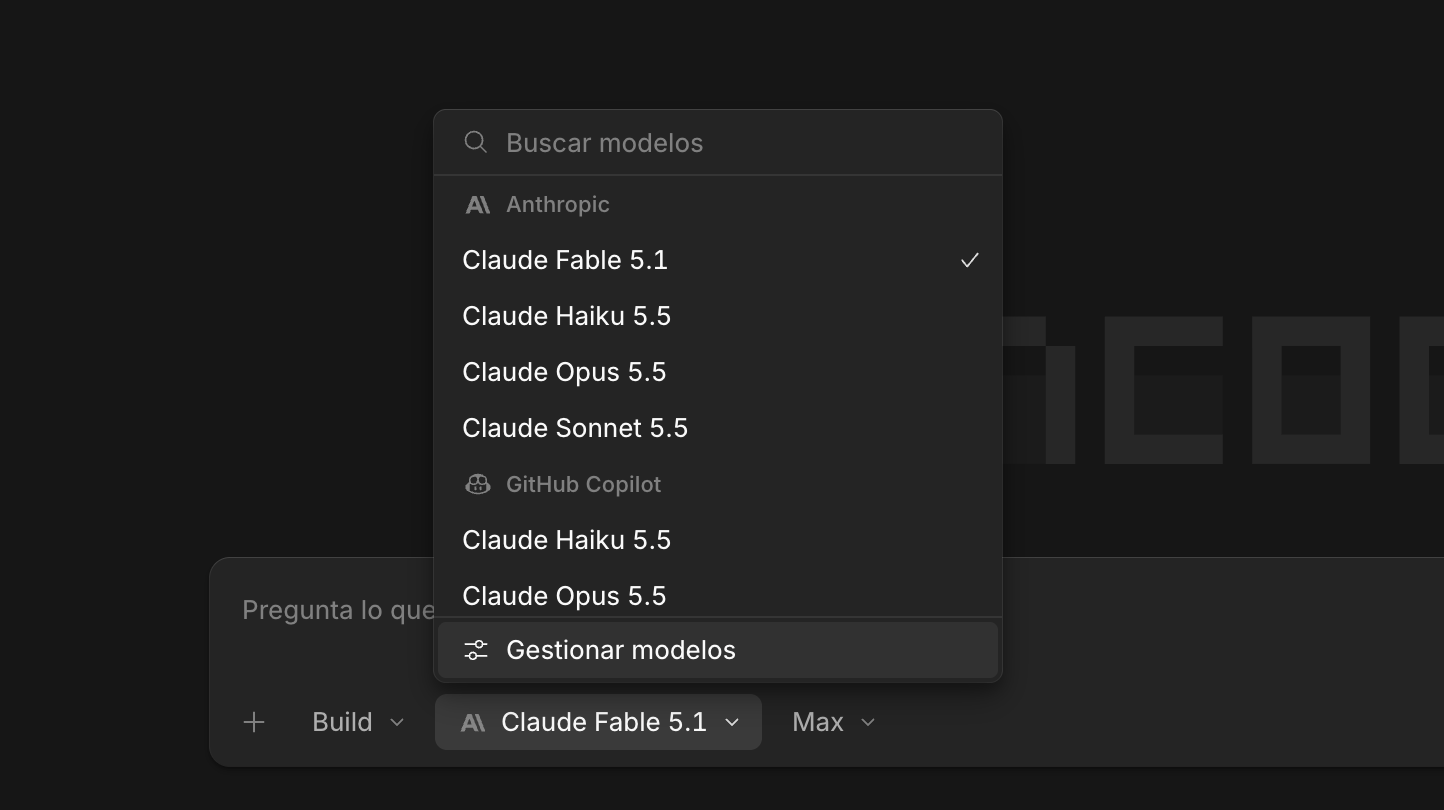
[!IMPORTANT] Connecting or using Claudeway may renew tokens and update Claude Code's credential source. Do not copy tokens by hand or choose the API-key method. Loading the plugin alone does not connect any account.
Update, pin a version, install from Git or restart the service
To update only this plugin:
opencode plugin update @tamelabs/opencode-claudeway
To pin a version, use @tamelabs/opencode-claudeway@0.1.0. To try the main
branch without npm:
opencode plugin add 'git+https://github.com/tamecl/opencode-claudeway.git#main'
If you already installed it from Git, SSH or a local path, remove that entry before adding the npm one; do not keep two copies.
If the plugin does not show as active, you can restart the service. This may interrupt other sessions:
opencode service restart
opencode plugin list
Alternative: load the local directory
After installing the repository's dependencies, add its path to the V2 configuration of the project where you want to try it:
{
  "$schema": "https://opencode.ai/config.json",
  "plugins": ["/absolute/path/to/opencode-claudeway"]
}
Then enable Claudeway through /connect, as in the manual install.
Use the local directory or the published package, not both.
Automatic renewal
When you connect Claudeway or request a model, it renews if five minutes or less of validity remain. Otherwise it makes no extra calls or writes.
- Coordination: a shared Promise and a file lock coordinate Claudeway processes. The source is re-read before renewing and before writing.
- Persistence: keeps scopes and other metadata, updates the same source and returns the grant to V2's OAuth callback. Files are replaced atomically with private permissions.
- Recovery:
.claudeway-refresh.jsonholds new tokens only while a write is pending, with POSIX0600permissions. Afterwards only a receipt with hashes remains, no tokens. Do not share it or delete it blindly. - Bounded failures: the OAuth request has a fixed destination, a timeout and blocked redirects. Transient rejections get a cooldown; terminal ones ask you to re-authenticate. An uncertain result never replays the old refresh token.
Claude Code is not required to honor our lock. Re-reads reduce races but cannot guarantee absolute exclusion against other clients, nor recovery after a crash before the OAuth response is persisted.
Dedicated token (avoids clashes with Claude Code)
Claudeway and Claude Code share a rotating refresh token, so they can collide
when renewing (symptom: OAuth renewal is rate-limited). To avoid it, store a
separate year-long token (claude setup-token) in the Claudeway-token Keychain
item (macOS) or in ~/.claude/.claudeway-token with 0600 permissions (Linux).
When present, Claudeway uses it as-is: it never reads or renews Claude Code's
credentials. A 401 means you need to repeat setup-token. Steps in
installation.md.
Not supported on Windows.
Security and limits
What has been verified
| Path | Current evidence |
|---|---|
| Real generation with a subscription | Working on OpenCode 2.0.29, no API key. |
| JS implementation and renewal | Fixtures and V2 host SDK; one expired-session renewal and subsequent generation returned HTTP 200 on macOS (2026-10-20). |
| macOS | Real generation with Haiku 5.5, Sonnet 5.5 and Opus 5.5. Real Keychain renewal verified; 91 automated tests pass. |
| Linux (Ubuntu) | Real generation with Haiku 5.5, Sonnet 5.5, Opus 5.5 and Fable 5.1. Real renewal and automated tests pending. |
| Windows | Pending. Renewal is disabled until private ACLs are verified. |
Limits you should know
- Redirects: the host may follow the first request and resend the body. Blocking redirects in OAuth or in the verifier does not fix that transport.
- Instruction priority: compatibility moves instructions from
systemto the first user message, lowering their priority. That is not equivalent to keeping them insystem; OpenCode's permission checks are unchanged. - Keychain: updates longer than
security -i's safe line (4094 bytes) are rejected, never truncated. - Single source: honors
CLAUDE_CONFIG_DIR; does not discover other accounts. On macOS the file is used only if the matching Keychain item does not exist. - No secret logging: never logs tokens, prompts or error bodies. Keychain writes go through stdin, never arguments or environment.
- Limited scope: no multi-account, routing, proxy, telemetry or background refresh. The fallback for known 400/429 errors removes only betas that are present, with up to two retries; it does not recover 401 errors.
Renewal modifies the selected Claude Code source, not auth.json.
Using subscription credentials in unofficial clients may be restricted by
Anthropic's terms and may stop working.
See the compatibility report (Spanish) for results, diagnostic history and the full list of limitations.
FAQ
How do I use my Claude Pro or Max subscription in OpenCode?
Install Claudeway (opencode plugin add @tamelabs/opencode-claudeway), connect
Claude Code credentials (Claudeway) in /connect and pick a model in
/models. You need an existing Claude Code session.
Do I need an Anthropic API key? No. Claudeway uses Claude Code's OAuth credentials, not an API key.
Which models work?
Tested with real generation on OpenCode 2.0.29: Claude Haiku 5.5, Sonnet 5.5
and Opus 5.5 on macOS, plus Fable 5.1 on Ubuntu.
Which operating systems are supported? macOS and Linux. On Windows renewal is disabled until private ACLs are verified.
Is it free and open source? Yes, MIT licensed. You need your own Claude subscription.
Does it work with OpenCode V1? No. Claudeway targets OpenCode V2 only.
How is it different from opencode-claude-auth? Claudeway is an independent project for OpenCode V2, based on a selective migration of opencode-claude-auth. It adds on-demand OAuth renewal with file locking, recovery from interrupted writes and an optional dedicated token to avoid clashing with Claude Code.
Is it allowed by Anthropic? It is unofficial. Using subscription credentials in unofficial clients may be restricted by Anthropic's terms and could stop working at any time.
Development
Node 24.12+ · pnpm 10.32.1 · OpenCode 2.0.29
pnpm install --frozen-lockfile
pnpm test
pnpm run lint
pnpm pack
Without pnpm, replace pnpm with npx --yes pnpm@10.32.1.
The package loads src/index.js directly, with no dist/ or helper interpreter.
Regular tests never use real credentials or call Anthropic: they isolate the
environment and use fixtures, in-memory SQLite and a mocked transport.
See CONTRIBUTING.md.
Project map
| File | Responsibility |
|---|---|
src/index.js |
V2 integration and allowed destinations. |
src/storage.js |
File/Keychain, validation, persistence and locking. |
src/credentials.js |
OAuth renewal, concurrency and recovery. |
src/transforms.js |
Billing, identity, instructions, Haiku and tools. |
src/compatibility.js |
Headers, fallback and streaming. |
src/errors.js |
Codes and sanitized messages. |
test/ |
Behavior and V2 host tests. |
scripts/diagnostics.mjs |
Sanitized comparison and manual probe diagnostics. |
Optional live check — requires authorization
This verifier is not part of the regular tests. It reads real credentials and may consume account usage. Do not run it without explicitly authorizing that.
node scripts/verify-live.mjs --confirm --max-requests=3
- Allows one minimal request and up to two retries within the total budget.
--max-requestsdefaults to1; each request is capped at eight output tokens and requires Bearer auth, no API key and the official destination. - Never renews tokens or writes their sources. It disables automatic renewal and rejects credentials sixty seconds or less from expiry.
- Blocks redirects in its isolated transport, not in the production plugin.
- Waits for OAuth to finish and distinguishes initialization, credentials and request. The report omits tokens, prompts, session IDs and raw errors; its structural diffs do not prove which adaptation alone fixed the earlier error.
Removal
opencode plugin remove @tamelabs/opencode-claudeway
If you connected a test account, remove only that account from the native UI; do not delete Claude Code's credentials. The plugin keeps no timers or persistent processes.
Credits and license
Independent project based on a selective migration of opencode-claude-auth, not a modification of that repository. Community references do not constitute authorization to use the service.
Similar plugins

Claude Subscription
opencode-claude-subscription
OpenCode v2 plugin: use your Claude Pro/Max subscription with OpenCode's built-in Anthropic provider.

Claude Quota
opencode-claude-quota
Claude Code usage, quota and rate limits (5h session, weekly, per-model) in the OpenCode v2 sidebar.

With Claude
opencode-with-claude
OpenCode plugin to use your Claude Max subscription via Meridian proxy