
Pi Weave
Local-first Markdown memory and knowledge graph for Pi and OpenCode: preserve decisions, recall sessions, and explore notes with code.
3
+1 in 30 days
4,453
1.4k in 7 days
49.4
Multi-signal model
15 hours ago
2026-10-04
Install and configure
opencode.jsonWrites to this project's opencode.json — applies to this repository only.
opencode.json
{
  "$schema": "https://opencode.ai/config.json",
  "plugin": ["pi-weave@0.3.6"]
}
Writes to ~/.config/opencode/opencode.json — applies to every project.
~/.config/opencode/opencode.json
{
  "$schema": "https://opencode.ai/config.json",
  "plugin": ["pi-weave@0.3.6"]
}
If you want to modify the plugin locally, install it into the project and reference the local path.
shell
pnpm add -D pi-weaveOpenCode loads npm dependencies through its embedded runtime on startup and caches them locally — no manual global install needed.


Your notes. Your agent's notes. One searchable knowledge workspace.
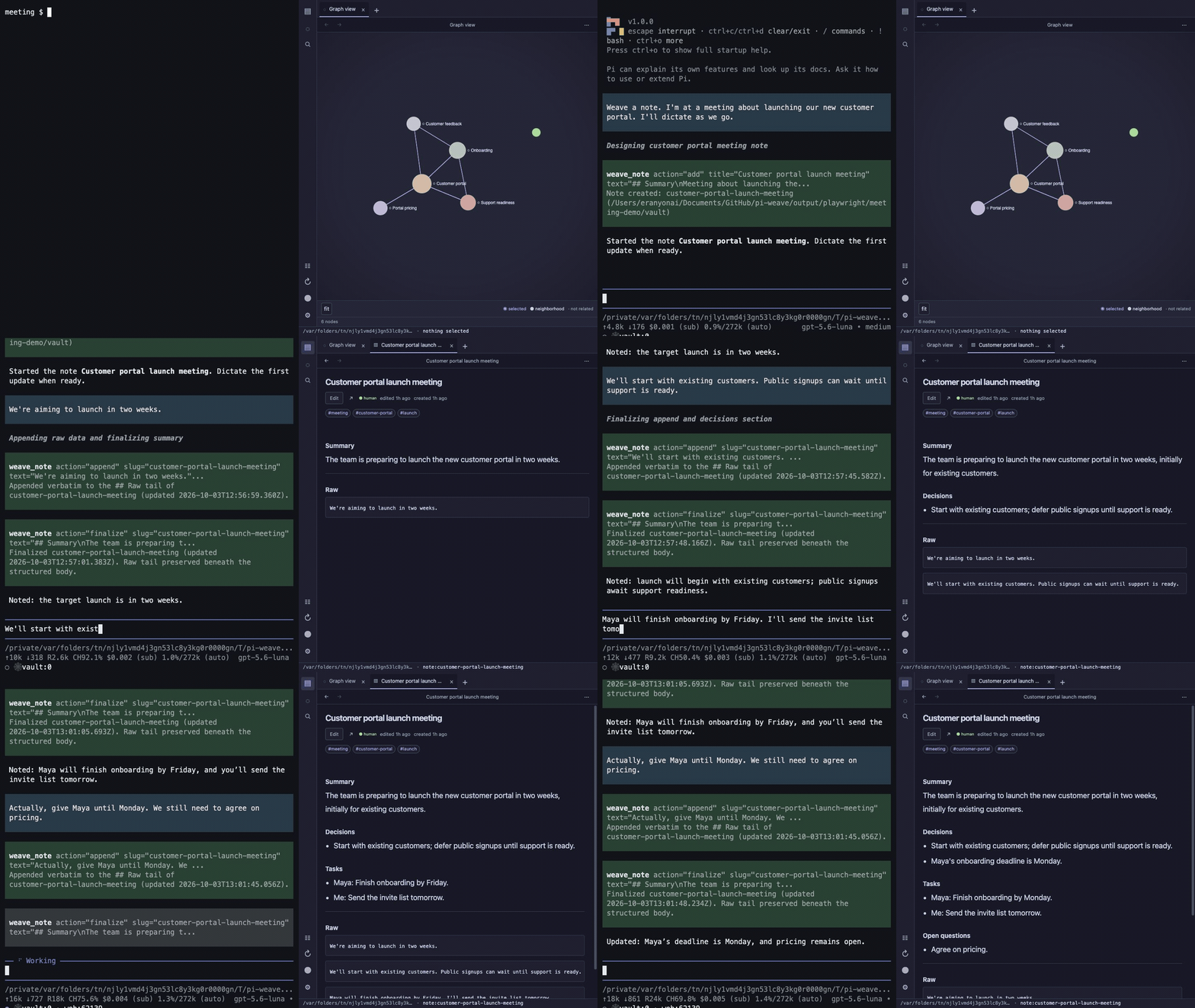
I've been chasing the right note-taking workflow for years. Notion, OneNote, Obsidian, and plenty of others.
With pi-weave, I've made one that finally answers the way I want to work today — especially now that AI agents are part of that work.
The idea is simple:
You and your agent should share the same knowledge.
Talk naturally and let your thoughts become structured notes. Write notes yourself. Let your agent capture decisions, discoveries, and useful context. Bring important knowledge forward from previous sessions.
Then find it again — by searching the workspace yourself, or simply asking your agent.
Everything is local. Everything is readable. Your notes are ordinary files, not knowledge trapped inside another chat.
Think out loud
Dictation is one of my favorite ways to use AI.
Instead of stopping to organize every thought while I'm having it, I can just talk:
Start a note about pi-weave positioning. I'm going to think out loud.
pi-weave keeps what I actually said while Pi continuously turns it into a useful, structured note.
The raw thought stays yours. The organization is handled for you.
And it doesn't end with human notes.
Your knowledge + your agent's knowledge
pi-weave gives humans and agents one workspace.
A note you dictate, something you write manually, a useful discovery made by an agent, or knowledge recovered from an earlier session can all live together.
pi-weave keeps track of where knowledge came from, while making the whole workspace searchable by both you and your agent.
The conversation can end. The knowledge doesn't have to.
Install
pi-weave supports Pi and OpenCode (V1 1.18.29+ and V2) from the same package. The adapters share the vault, repository index, browser workspace, tools, and skills.
OpenCode V2:
opencode plugin add pi-weave
OpenCode V1 1.18.29+: add the package to both opencode.json (server) and tui.json (browser opening):
{ "plugin": ["pi-weave"] }
Pi:
pi install npm:pi-weave
Other install sources:
pi install git:github.com/EranYonai/pi-weave
pi install /path/to/pi-weave
Requires Node 20.13 or newer.
Then just talk to your agent.
Start taking notes
Talk to Pi normally:
You: Start a note called Authentication migration.

You: We probably want OIDC next quarter, but existing JWT clients need
     a compatibility window.

You: Add that the gateway team owns the migration plan.

You: What open questions are in this note?
For live narration or interview notes, tell your agent that you are dictating:
You: Start a note for this interview. I’m going to narrate; keep my words
     verbatim and organize the note as we go.
For each chunk, the agent:
- appends your words unchanged to the note’s
## Rawtail; - refreshes the structured summary above it;
- leaves the raw record untouched.
This makes the note readable during the conversation without replacing your words with an AI reconstruction. Notes based on your dictation
remain marked source: human; notes drafted by the agent are marked source: agent.
Useful requests include:
| Say this | What happens |
|---|---|
| “Start a note about…” | Creates a Markdown note in the vault |
| “Add this to the … note” | Finds the existing note and appends to it |
| “Clean up” or “finalize this note” | Reorganizes the readable body and preserves the raw tail |
| “What did we decide about…?” | Searches the vault, then reads the relevant notes |
| “Remember that…” | Stores durable knowledge for a future session |
| “Fix the broken links” | Audits and repairs stale [[wiki-links]] deterministically |
Keeping the vault connected
A wiki-link resolves to nothing when it is written as a bare title — [[Quarterly Roadmap]] when the note lives at planning/roadmap-2026
— or when it points at a note that was never written. Pi repairs those in one deterministic pass instead of rereading the vault and
guessing.
You: Check the links in my notes.
You: Fix the ones you're sure about.
A target resolves by exact slug, then unique basename, then unique title — each rule requiring exactly one candidate. Ambiguous links
are reported with their candidates and never guessed; links to notes that were never written are listed, never invented. Repairs preserve
the alias, so the visible text does not change, and never touch the ## Raw tail or code fences.
Renaming or moving a note rewrites its inbound links automatically, so its backlinks stay intact.
/weave-view
/weave-view              # open the browser workspace
/weave-view --no-open    # start it and print the URL
/weave-view tui          # Pi only: terminal UI for SSH or browser-free use
Browse and search your notes, follow links, or explore the graph. Use tabs and split panes to keep related notes side by side. Notes update within a couple of seconds as your agent writes them.
Ask your agent to write, organize, and connect notes, or click New note on an empty tab to start one yourself.
Click Edit to change Markdown and ⌘S / Ctrl S to save. Your original words in ## Raw stay intact.
Tabs, layout, and settings restore when you return and survive package updates for the same vault and repository;
unsaved drafts last only while the browser stays open.
Use Settings for themes, fonts, layout, and a manual vault ZIP backup. Press ? for keyboard shortcuts.
/weave-view tui opens a smaller, read-only terminal explorer in Pi.
Remember sessions
/weave-scan sessions                    # Pi history, or the current OpenCode session
/weave-scan sessions /path/to/history   # explicit history root
This opt-in scan treats a supplied file—or every bounded text file under a supplied directory—as opaque session material for the active
model to interpret, then writes generated notes under ~/.okf/notes/sessions/. In OpenCode, the pathless form reads the current session
through the public plugin API; it never inspects OpenCode's internal database. That makes explicit paths usable with Claude Code, OpenCode,
Codex, or exported history trees without requiring their schema or file extension. It skips unchanged files, captures outcomes plus reusable
technical takeaways, works outside Git repositories, and can be stopped with /weave-scan-cancel.
Repository knowledge
Inside a Git repository, pi-weave detects whether <repo>/.okf/ is missing, fresh, or stale.
/weave-scan         # fast structural index
/weave-scan deep    # also summarize changed files with the active model
The light index covers languages, packages, modules, entry points, and Git state. A deep scan adds short per-file summaries and only revisits files whose content changed.
The repository index is a cache, not a source of truth. Delete .okf, scan again, and nothing important is lost. pi-weave excludes it
locally from Git by default.
Commands and tools
Most people only need natural language and /weave-view.
| Surface | Name | Purpose |
|---|---|---|
| Command | /weave-view |
Open the browser workspace (tui is a Pi-only argument) |
| Command | /weave |
Show vault and repository status |
| Command | /weave-scan |
Build or refresh the repository index |
| Command | /weave-scan deep |
Add incremental model-written file summaries |
| Command | /weave-scan sessions [path] |
Turn changed session-history files into durable memory notes |
| Command | /weave-scan-cancel |
Stop a deep or session scan |
| Tool | weave_note |
List, read, add, append, finalize, and search notes |
| Tool | weave_repo |
Check, scan, and summarize the repository index |
The included weave-notepad and weave-explore skills teach Pi and OpenCode when and how to use these tools. In OpenCode, /weave shows
vault/repository status and scan progress appears in toasts; Pi keeps its persistent status line. V1 slash commands use its standard prompt
pipeline, so the model reports command results in the conversation. /weave does not open a dialog. V1 scans use the model from your last
chat message: send a message after selecting a model, then scan. Generation runs in temporary child sessions with tools denied;
those sessions are removed on completion or cancellation. V2 uses its direct command and generation APIs.
Files, privacy, and portability
Personal notes are ordinary Markdown files:
~/.okf/
└── notes/
    ├── authentication-migration.md
    └── release-plan.md
A note has small YAML front matter followed by Markdown:
---
title: Authentication migration
created: 2026-08-22T09:00:00.000Z
updated: 2026-08-22T09:30:00.000Z
tags: [auth, security]
source: human
---

## Summary

Move toward OIDC while keeping a JWT compatibility window.

---

## Raw
<!-- NEVER edit below this line. Verbatim user input preserved here. -->

```
We probably want OIDC next quarter…
```
Set PI_WEAVE_VAULT to use a different vault location.
Reading, writing, searching, and viewing notes are local operations. Deep repository scans and session summaries send bounded input to the active Pi/V2 model or the last-used V1 chat model. The browser workspace binds only to loopback, uses a per-session token, and shuts down with the plugin lifecycle. OpenCode opens it automatically when the terminal can reach the viewer's loopback URL. Otherwise, it shows the exact URL for a browser or tunnel.
The vault format, repository index, and skills are intentionally harness-agnostic. src/core contains no Pi- or OpenCode-specific imports.
Development
The OpenCode V1/V2 bindings share tool schemas, core actions, and one command/scan workflow. Zod is the only direct runtime dependency, required by V1's tool-schema protocol; OpenCode SDKs are development-only.
npm install
npm run check
Useful individual commands:
npm run typecheck
npm test
npm run coverage
npm run build:web
Coverage must remain at or above 95% for lines, branches, functions, and statements. If browser source changes, rebuild and commit
src/web/client/dist/app.js.
Read AGENTS.md before contributing. Work on a feature branch; do not commit directly to main.
More detail
- Design — product and architecture
- Notepad skill — capture, narration, and provenance behavior
- Link repair reference — how stale links resolve, and what repair will not do
- Historical browser workspace notes — superseded implementation record
- Repository exploration skill — how Pi uses the index
License
Similar plugins

Claude Memory
opencode-claude-memory
OpenCode plugin for Claude Code memory: persistent, local-first shared memory with Claude Code-compatible Markdown files, LLM recall, in-process auto extraction, and auto-dream consolidation

Echoes Vault Opencode
echoes-vault-opencode
OpenCode adapter for the agent-neutral EchoesVault Protocol and repository-local Markdown memory runtime.

Flema Engram Sidebar
opencode-flema-engram-sidebar
Local-first OpenCode plugin/sidebar for Engram memory and SDD context, with an optional MCP stdio adapter