
Switchman
OpenCode orchestration plugin: six-lane shell matrix dispatch (hard ROUTE_META validation / breaker self-healing / probes / three-pool quota awareness / cost-aware tiebreaker)
1
1,314
25 in 7 days
41.1
Multi-signal model
15 days ago
2026-09-19
Install and configure
opencode.jsonWrites to this project's opencode.json — applies to this repository only.
opencode.json
{
  "$schema": "https://opencode.ai/config.json",
  "plugin": ["opencode-switchman@1.2.0"]
}
Writes to ~/.config/opencode/opencode.json — applies to every project.
~/.config/opencode/opencode.json
{
  "$schema": "https://opencode.ai/config.json",
  "plugin": ["opencode-switchman@1.2.0"]
}
If you want to modify the plugin locally, install it into the project and reference the local path.
shell
pnpm add -D opencode-switchmanOpenCode loads npm dependencies through its embedded runtime on startup and caches them locally — no manual global install needed.
English | 简体中文 | 繁體中文 | 日本語 | 한국어 | Español | Français | Deutsch | Italiano | Português | Русский
Also using zcode? Check out zcode-switchman — a sibling open-source project by the same author that brings the same orchestration to zcode users.
Context on a meter. Tasks dispatch themselves.
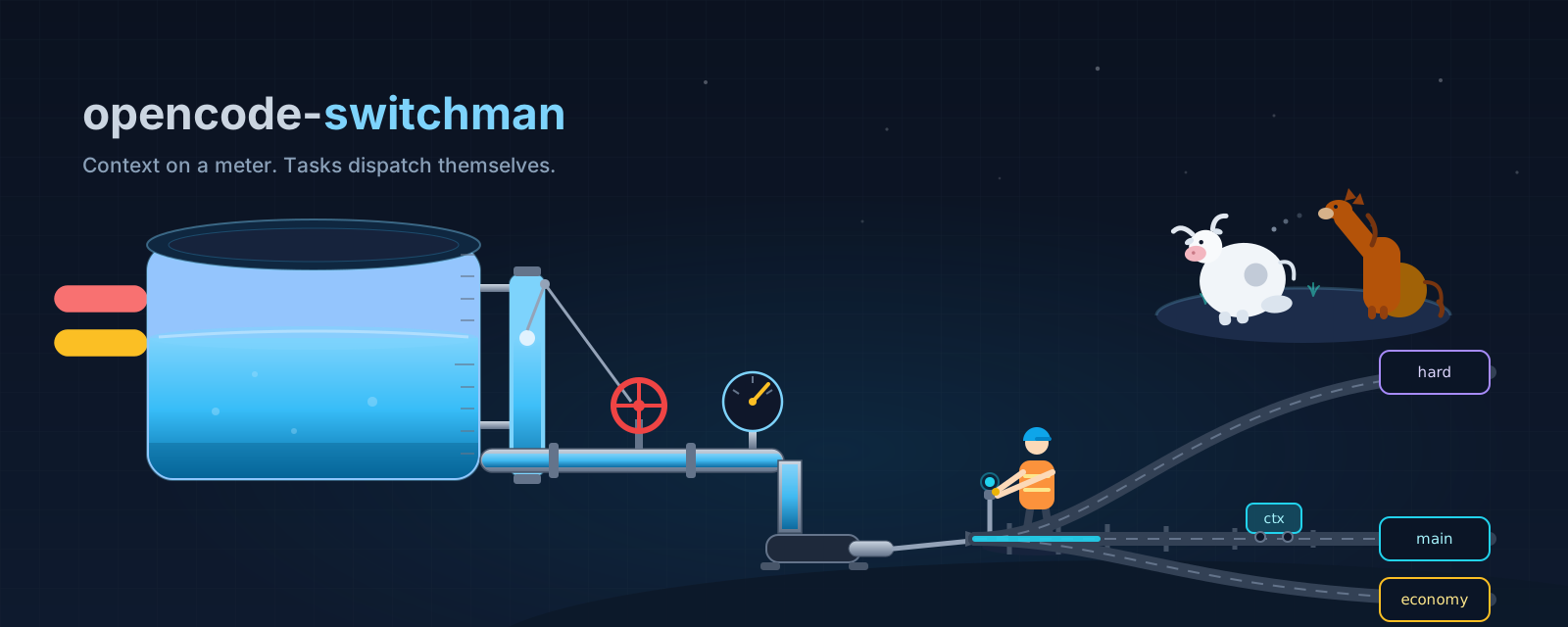
Interactive demo deck: opencode-switchman in action
An orchestration plugin for OpenCode. It does two things, and does them well:
1. Context water-level control. Your session's context is measured every turn. Reads run against a per-turn budget, so the model can't quietly gulp the whole repo; soft / hard / force watermarks trigger advice, then wrap-up, then an automatic backup-and-compact handover; every dispatched subagent carries its own hard cap. Context stops snowballing — a session can run all day without tokens being devoured by its own history.
2. Automated decision dispatching. Your primary model becomes a dispatcher: it profiles each task and delegates it to subagent shells across six cognitive lanes (economy / mechanical / main / hard / vision / review). The plugin enforces deterministic gates, weighted model scoring, and self-healing failure isolation, and logs every routing decision.
On top of that:
- Multiple models or subscriptions? This plugin was built for you. GitHub Copilot, GLM Coding Plan, DeepSeek — or any opencode provider — get orchestrated as one pool: quota-aware ordering, peak-window avoidance, forced cross-family review.
- Only one model? Still worth it. The context control and smart dispatch alone keep a single model usable indefinitely — no matter how long the session runs, the context never balloons.
Install
One command — covers first install and later updates. Restart opencode afterwards.
curl -fsSL https://raw.githubusercontent.com/mrzturn/opencode-switchman/main/scripts/setup.sh | bash
or
npx -y opencode-switchman@latest
or
bunx opencode-switchman@latest
Either path rewrites the plugin entry in your opencode config to the exact latest version and prunes stale caches. Manual npm install, from-source build, and the "why exact versions" note: Installation details.
Prefer hands-off? Let your AI do the installation — paste this prompt into the AI you're using:
AI-assisted install prompt
Please install and configure the opencode-switchman plugin for my opencode, strictly following its official instructions.

Official sources (authoritative, do not guess from memory):
- GitHub repo: https://github.com/mrzturn/opencode-switchman
- npm package: https://www.npmjs.com/package/opencode-switchman
Read the repo README's "Installation" section and follow it exactly.

Steps:
1. Install the latest version published on npm: run `npx -y opencode-switchman@latest` (or `bunx opencode-switchman@latest`) — it rewrites the `plugin` entry in my opencode config to the exact latest version (it also works in the project-level `opencode.json` if that is what I use).
2. Complete the functional configuration: all plugin settings live in the standalone `opencode-switchman.jsonc` in my opencode config directory, auto-generated with defaults and inline comments on first start; check it against my providers (e.g. `zhipuai-coding-plan` / `deepseek` / `github-copilot`) and adjust as needed.
3. Verify correctness so opencode loads, starts, and runs the plugin: run `/switchman-doctor` inside opencode for a local credential-free diagnostic report and fix every error it reports; then restart opencode and confirm the plugin actually loaded — the log should contain `[opencode-switchman] injected N model shells (agents)` and my primary model's system prompt should carry the live `[ROUTES]/[WATERMARK]/[LIMITS]` banner block.

Do not declare success until all three steps pass; report what you changed and show the verification evidence.
Prerequisites: opencode, CLI/TUI recommended (dialogs, sidebar, and banners are richest there; the desktop app shares the same config and state). Any provider works; Copilot / GLM / DeepSeek additionally get quota-aware routing. Credentials are read-only from opencode's own auth — the plugin never stores secrets.
Quick start
Six steps. Full walkthrough with screenshots: docs/quick-start.md / 中文.
- Connect providers —
/connectin the TUI: Copilot OAuth, DeepSeek API key; GLM Coding Plan goes intoopencode.jsonas thezhipuai-coding-plancustom provider. - Pick the models that join orchestration —
/modelsthenctrl+fto favorite (desktop app: "Manage models" toggles). /switchman-setup(required once) — the guided wizard covers the whole matrix in one pass: multi-select at least one model for each of the six task pools (economy / mechanical / main / hard / vision / review), then rank the selected models strongest-first. No TUI?/switchman-setup-chatruns the same guided flow in chat. Until setup completes, task dispatch is hard-blocked — unconfigured pools no longer default to "all models". Saved config hot-reloads; a restart is only needed to register brand-new providers.- Fine-tune (optional) —
/modelRankhand-tunes the capability ranking and/poolConfigcurates per-pool candidate lists in TUI dialogs (-chatvariants in chat); manual entries override the initial defaults everywhere. - Context commands
/handover— back up the session and compact it yourself. Use it when the[WATERMARK:SESSION]line is getting large or the task hits a good stopping point, instead of waiting for the automatic handover./ctx-pause— turn off this session's read limits and auto-handover. Use it when you need to read many large files at once and don't mind spending the tokens; measurement keeps running./ctx-resume— turn the limits back on. Use it as soon as the heavy reading is done; restarting opencode has the same effect.
- Restart and verify — check the
[ROUTES]/[LIMITS]banner and the sidebarswitchmanpanel; run/switchman-doctorif anything looks off. Then just use opencode normally.
What you get
Core
- Context water-level control — live session measurement (
[WATERMARK:SESSION]), soft/hard/force thresholds, a per-turn read budget that auto-bounds over-eager reads, a hard cap with summary-and-terminate for every subagent, and an auto handover (full backup fork + compaction) at force level. - Automated decision dispatching — a bundled dispatcher protocol turns your primary model into a dispatcher; six cognitive lanes route work to the right model at the right effort; six deterministic gates check every dispatch; failures trip breakers and isolation, and the system heals itself.
Extras
- Multi-subscription orchestration — quota-aware routing across Copilot / GLM / DeepSeek (any provider participates), peak-window yield, billing-aware scoring, cross-family review enforcement.
- Manual overrides —
/switchman-setup,/poolConfig,/modelRank,/expert,/handover,/ctx-pause,/ctx-resume,/switchman-doctor,/switchman-update. - Visibility — live four-line banner in every system prompt, TUI sidebar panel, tmux pane mirroring, per-session artifact workspace, and an audit log of every routing decision.
Full options table, architecture, and internals: docs/reference.md (中文: docs/reference.zh.md).
Documentation
- Quick start (illustrated): English · 中文
- Full manual (config, commands, architecture): English · 中文
- Technical spec (contracts / algorithms / field-test notes): docs/2026-08-28-opencode-switchman-technical-design.md
- Release notes: CHANGELOG.md
Roadmap
Near-term: quota support for more providers — more subscription plans and pay-as-you-go pools beyond Copilot / GLM / DeepSeek. If your provider isn't covered yet, open an issue: real usage decides what gets built next. Suggestions and bug reports are equally welcome.
Support the author
This plugin is open source and free to use, and it will stay that way. Keeping it alive isn't free, though: supporting and testing adapter compatibility across providers means holding multiple subscriptions and debugging them one by one — every round costs real money.
If the plugin has genuinely helped you and your budget allows, buy me a coffee. Thank you — sincerely.
👇
☕ Click here 【Buy the author a coffee】
| Alipay | WeChat Pay | Scan with WeChat to give him a like |
|---|---|---|
 |
 |
 |
License
Similar plugins

Subagent Magazine
opencode-subagent-magazine
OpenCode TUI plugin monitoring sub-agent invocation status in real time

Nexus
@serkanalgur/opencode-nexus
Adaptive Multi-Agent Orchestration with Cost Intelligence for OpenCode V2

Loopd
@bojackduy/opencode-loopd
Codex-inspired background goal engine for OpenCode — autonomous subagents, engine-driven loop, child worker sessions and modal TUI dashboard. Like Claude Code loop for OpenCode.