
Omniroute Router
Deterministic task routing plugin for OpenCode on top of a self-hosted OmniRoute gateway: classifies requests into five tiers, delegates to exactly one worker per turn, and records execution history.
0
74
16 in 7 days
30.0
Multi-signal model
1 month ago
2026-09-01
Install and configure
opencode.jsonWrites to this project's opencode.json — applies to this repository only.
opencode.json
{
  "$schema": "https://opencode.ai/config.json",
  "plugin": ["opencode-omniroute-router@0.2.0"]
}
Writes to ~/.config/opencode/opencode.json — applies to every project.
~/.config/opencode/opencode.json
{
  "$schema": "https://opencode.ai/config.json",
  "plugin": ["opencode-omniroute-router@0.2.0"]
}
If you want to modify the plugin locally, install it into the project and reference the local path.
shell
pnpm add -D opencode-omniroute-routerOpenCode loads npm dependencies through its embedded runtime on startup and caches them locally — no manual global install needed.


Deterministic multi-model task routing for OpenCode on top of a self-hosted OmniRoute gateway.
You describe a task. A lightweight orchestrator classifies it with static rules, and a dispatch plugin deterministically routes it to exactly one worker agent — so you never pick a model by hand, and premium quota (Codex/Claude) is only spent on work that actually needs it.
you → opencode → smart-orchestrator (classifies) → 1 worker → OmniRoute → provider/model
How it works
- You type a task in plain language.
smart-orchestratorclassifies it on five dimensions: task type, scope, risk, ambiguity, verification.- The plugin rewrites the Task target deterministically — the LLM proposes, the plugin decides.
- The selected worker solves the task through your OmniRoute gateway, which picks the concrete provider/connection with fallback.
Tiers
| Tier | Worker | Kind of work | Execution |
|---|---|---|---|
| Free | free-worker |
Informational: explanations, docs lookups, reading code | read-only |
| Fast | smart-fast |
Mechanical, behavior-preserving (typos, renames, formatting) | editor |
| Standard | smart-standard |
Features, known bugs, endpoints, tests | editor |
| Strong | smart-strong |
High ambiguity, cross-system, risky | editor |
| Expert | expert |
Critical: concurrency, memory leaks, security, repeated failures | editor |
Workers may read the repository, run a strict allowlist of commands, and — except for the free tier — edit files, create feature branches and commit. After changes they must run verification (tests/build/lint) and report real output. They can never push, rebase or run destructive git commands — final review and push always belong to you.
When a request reports a symptom with an unknown/intermittent cause, the orchestrator first runs one read-only exploration with the built-in explore agent, then delegates.
Guarantees enforced by the plugin, per user turn: at most one exploration (never after dispatch) and exactly one worker Task.
Install
Prerequisites: OpenCode and a running OmniRoute gateway (local or remote, e.g. Docker).
Step 1 — Install and start OmniRoute
OmniRoute is the gateway that holds your providers (OAuth subscriptions, API keys, free pools) and serves one OpenAI-compatible endpoint.
npm install -g omniroute
omniroute serve            # dashboard + API at http://localhost:20128
Then connect at least one provider from the dashboard (http://localhost:20128 → Providers), e.g. OAuth for Codex/Gemini or any API-key provider. The built-in free channels (auto/*, opencode/*) work out of the box with zero credentials.
For a permanent deployment (home server, VPS), OmniRoute ships an official Docker image (
diegosouzapw/omniroute) and a daemon mode (omniroute serve --daemon). Bind it to loopback or a private network and enableREQUIRE_API_KEY=truebefore exposing it anywhere.
Step 2 — Create an API key and wire OpenCode to it
# Open the dashboard, sign in and create a client API key (Keys section),
# or set REQUIRE_API_KEY=false for a local-only, keyless setup.
export OMNIROUTE_API_KEY='your-client-key'

# Generate the omniroute provider in your OpenCode config (official command):
omniroute setup-opencode                       # local gateway
omniroute setup-opencode --remote http://<host>:20128 --api-key "$OMNIROUTE_API_KEY"

# Verify the gateway is reachable:
curl -s -o /dev/null -w '%{http_code}\n' http://localhost:20128/v1/models \
  -H "Authorization: Bearer $OMNIROUTE_API_KEY"    # expected: 200
Step 3 — Install this plugin
# Scaffold the agents + plugin config into your project:
npx opencode-omniroute-router init
# or globally (all projects):
npx opencode-omniroute-router init --global
# then use OpenCode normally:
opencode
> Fix the bug where the login form rejects valid emails
init flags: --global, --orchestrator <model>, --free <model>, --fast <model>, --standard <model>, --strong <model>, --expert <model> — model IDs use the provider/model format from your config (e.g. omniroute/auto/coding, or a named combo like omniroute/combo/free-fast).
Which models should I use? After
setup-opencode, list your catalog withomniroute models(orGET /v1/models). Theauto/*channels always exist; named combos created in the OmniRoute dashboard (e.g. a free-first chain for the low tiers, a premium chain for expert) are ideal tier targets — pass them via theinitflags above.
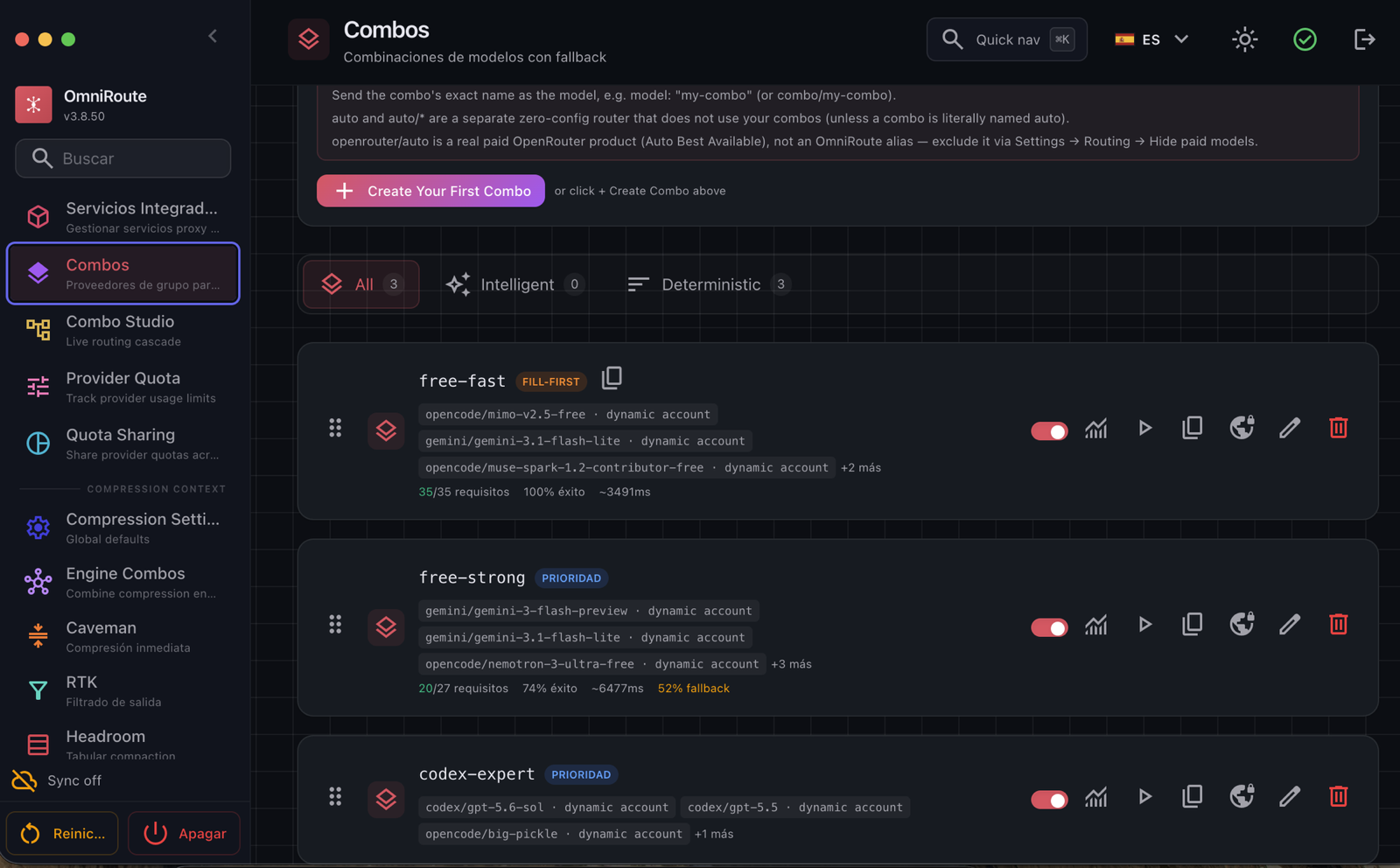
Example: three dashboard combos designed exactly for this plugin's tiers — a fill-first free chain for fast work, a quality-first free chain for standard tasks, and a Codex-first chain for the expert tier, with live success rates and fallback stats per combo:
Configuration
Plugin options are passed in opencode.json and all have defaults:
{
  "plugin": [["opencode-omniroute-router", {
    "workers": { "free": "free-worker", "fast": "smart-fast", "standard": "smart-standard", "strong": "smart-strong", "expert": "expert" },
    "models": { "smart-fast": "omniroute/auto/fast", "expert": "omniroute/auto/coding:pro" }
  }]]
}
workers— tier → agent name mapping. If provided, tiers are inferred from its keys; you can use fewer tiers.models— worker → model id, used in the execution history log.exploreAgent— name of the read-only exploration agent (defaultexplore).historyDir— where the JSONL history is written (default~/.smart-opencode).
Execution history & stats
Every dispatch and outcome is appended to ~/.smart-opencode/history.jsonl:
{"timestamp":"...","type":"dispatch","sessionId":"...","tier":"standard","model":"omniroute/auto/coding","request":"..."}
{"timestamp":"...","type":"outcome","sessionId":"...","outputChars":755,"verificationEvidence":true,"preview":"..."}
Aggregate statistics (per model, per task type, and a task-type × model success matrix):
npx opencode-omniroute-router stats        # human-readable report
npx opencode-omniroute-router stats --json # machine-readable
This is the data foundation for adaptive routing (roadmap).
Roadmap
- Adaptive routing: score models from real execution history (success probability × task fit − quota cost)
- Explore/exploit scheduling between similar models
- Contextual bandit over task features
- Per-project and per-technology statistics
Development
npm install
npm test
License
Español
Enrutado determinista multi-modelo para OpenCode sobre una pasarela OmniRoute autoalojada.
Tú describes la tarea; un orquestador ligero la clasifica con reglas estáticas y un plugin de dispatch la delega a exactamente un worker — sin elegir modelos a mano y gastando la cuota premium sólo cuando hace falta.
Los workers pueden leer y editar el repositorio, crear ramas y hacer commit (salvo el tier gratuito, de solo lectura), con una allowlist estricta de comandos: nunca hacen push, rebase ni operaciones destructivas — la revisión final y el push son tuyos. Ante síntomas de causa desconocida, el orquestador lanza antes una exploración read-only.
Instalación: npm i -g omniroute && omniroute serve (conecta proveedores en el dashboard), luego omniroute setup-opencode para enlazar OpenCode, y npx opencode-omniroute-router init (+ --global para todos tus proyectos). Historial en ~/.smart-opencode/history.jsonl, estadísticas con npx opencode-omniroute-router stats.
Similar plugins

Comment Judge
opencode-plugin-comment-judge
opencode plugin and Claude Code hook that has a model judge every comment an agent writes, and removes or rewrites the ones that do not earn their place

Fusion
@carson2222/fusion
Fan a hard prompt out to a panel of models in parallel as read-only explorers, then aggregate their findings into one answer. An OpenCode plugin.
Comment Judge
@smykla-skalski/opencode-plugin-comment-judge
opencode plugin and Claude Code hook that has a model judge every comment an agent writes, and removes or rewrites the ones that do not earn their place