
Supercode Token Usage Panel
OpenCode TUI sidebar section: cumulative token usage and cost of the current session family.
2
+1 in 30 days
1,305
406 in 7 days
45.2
Multi-signal model
6 days ago
2026-09-29
Install and configure
opencode.jsonWrites to this project's opencode.json — applies to this repository only.
opencode.json
{
  "$schema": "https://opencode.ai/config.json",
  "plugin": ["@glaicer/supercode-token-usage-panel@1.4.0"]
}
Writes to ~/.config/opencode/opencode.json — applies to every project.
~/.config/opencode/opencode.json
{
  "$schema": "https://opencode.ai/config.json",
  "plugin": ["@glaicer/supercode-token-usage-panel@1.4.0"]
}
If you want to modify the plugin locally, install it into the project and reference the local path.
shell
pnpm add -D @glaicer/supercode-token-usage-panelOpenCode loads npm dependencies through its embedded runtime on startup and caches them locally — no manual global install needed.
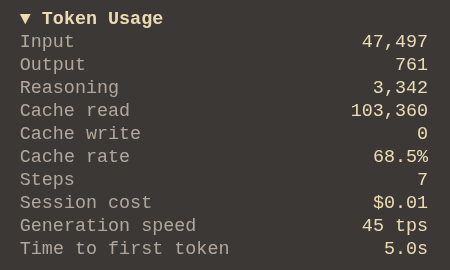
An OpenCode plugin that adds a collapsible Token Usage section to the TUI session sidebar. This section shows what the session actually costs: total input/output/reasoning tokens, cache rate, spend, speed, or how long the current turn has been running.
Totals fold in the whole session family: the parent session plus all subagent descendants, from OpenCode's own session.tokens / session.cost aggregates. When descendants contribute, their usage sums up with parent agent usage.
Requires OpenCode v2 (>=2.0.0). On OpenCode v1 stay on @glaicer/supercode-token-usage-panel@0.1.4.
Install
Install with the OpenCode CLI — it installs the package and registers the plugin in the global server configuration (~/.config/opencode/opencode.jsonc):
opencode plugin add @glaicer/supercode-token-usage-panel
Restart OpenCode after installing.
[!IMPORTANT] The first OpenCode load after installing this plugin may be slow. That's OpenCode downloading the plugin's packages and managed tools into its cache — it happens once. Every subsequent start is fast.
Manual install also works: add the package to the plugins array in ~/.config/opencode/opencode.jsonc:
{
  "plugins": ["@glaicer/supercode-token-usage-panel"]
}
Sidebar order
The panel claims after: "sidebar.content", and so do other plugins that extend the sidebar, so their relative order is the order in which they were registered. Entries in opencode.jsonc are always ordered before entries in cli.json, so register the panel here to place it relative to another sidebar plugin — for example, between context-progress-bar and session-recap:
{
  "plugins": [
    "@glaicer/supercode-context-progress-bar",
    "@glaicer/supercode-token-usage-panel",
    "@glaicer/supercode-session-recap"
  ]
}
The package ships a no-op server entry purely to make this possible: a ./tui-only package can only be registered in cli.json, which always sorts last.
Install on OpenCode v1
On OpenCode v1 install plugin version 0.1.4. Pin the version in the spec below; a bare package name resolves to latest, which requires OpenCode v2:
opencode plugin @glaicer/supercode-token-usage-panel@0.1.4 --global
--global(-g) writes into the global config (~/.config/opencode/tui.json); default is project-local (.opencode/tui.json).- If the plugin is already configured without a version, rerun with
--force(-f) to replace that entry with the pinned spec — otherwise the command reportsAlready configuredand keeps the unpinned entry.
Manual install also works: put the pinned spec in the plugin array of tui.json (global ~/.config/opencode/tui.json or local <project>/.opencode/tui.json):
{
  "plugin": ["@glaicer/supercode-token-usage-panel@0.1.4"]
}
v1 resolves the npm spec (including the version) and installs it automatically at startup — no npm install needed. Restart OpenCode after saving.
Development
npm run typecheck   # tsc --noEmit
npm test            # node --test, network-free: session history comes from fixtures
npm run build       # precompile Solid TSX into dist
npm pack --dry-run  # build and verify the publish artifact
Similar plugins

Session Viewer
@cedricg-dev/opencode-session-viewer
A local dashboard for [opencode](https://opencode.ai) that shows live session activity — messages, status, and model usage — in your browser.

Turn Stats
opencode-turn-stats
Current-turn processed-token count for the OpenCode sidebar

Token Usage
@chenlongapps/opencode-token-usage
Session-tree token usage, live performance, context window and estimated cost for OpenCode 2