
Mnemory
OpenCode plugin for mnemory — persistent AI memory with auto-recall, auto-capture, and explicit memory tools
279
+2 in 30 days
21
8 in 7 days
50.6
Multi-signal model
13 hours ago
2026-10-04
Install and configure
opencode.jsonWrites to this project's opencode.json — applies to this repository only.
opencode.json
{
  "$schema": "https://opencode.ai/config.json",
  "plugin": ["@fpytloun/opencode-mnemory@0.1.0"]
}
Writes to ~/.config/opencode/opencode.json — applies to every project.
~/.config/opencode/opencode.json
{
  "$schema": "https://opencode.ai/config.json",
  "plugin": ["@fpytloun/opencode-mnemory@0.1.0"]
}
If you want to modify the plugin locally, install it into the project and reference the local path.
shell
pnpm add -D @fpytloun/opencode-mnemoryOpenCode loads npm dependencies through its embedded runtime on startup and caches them locally — no manual global install needed.
mnemory
Give your AI agents persistent memory. mnemory is a self-hosted MCP server that adds personalization and long-term memory to any AI assistant — Claude Code, ChatGPT, Open WebUI, Cursor, or any MCP-compatible client.
Plug and play. Connect mnemory and your agent immediately starts remembering user preferences, facts, decisions, and context across conversations. No system prompt changes needed.
Self-hosted and secure. Your data stays on your infrastructure. No cloud dependencies, no third-party access to your memories.
Intelligent. Uses a unified LLM pipeline for fact extraction, deduplication, and contradiction resolution in a single call. Memories are semantically searchable, automatically categorized, and expire naturally when no longer relevant.
Features
- Zero config —
uvx mnemory, connect your MCP client, done. Works out of the box with any OpenAI-compatible API. - Intelligent extraction — A single LLM call extracts facts, classifies metadata, and deduplicates against existing memories.
- Contradiction resolution — "I drive a Skoda" + later "I bought a Tesla" = automatic update, not a duplicate.
- Two-tier memory — Fast searchable summaries in a vector store + detailed artifact storage (reports, code, research) retrieved on demand.
- AI-powered search — Multi-query semantic search with temporal awareness. Ask "What did I decide last week about the database?" and it finds the right memories.
- Memory health checks — Built-in three-phase consistency checker (fsck) detects duplicates, contradictions, quality issues, and prompt injection. Run manually or on a schedule with auto-fix.
- 10+ client support — Claude Code, ChatGPT, Open WebUI, OpenClaw, Cursor, Windsurf, Cline, OpenCode, and more. Native plugins available for automatic recall/remember.
- Built-in management UI — Dashboard, semantic search, memory browser with full CRUD, relationship graph visualization, and health check interface. No extra tools needed.
- Production ready — Qdrant for vectors, S3/MinIO for artifacts, API key or Cognis JWT authentication, per-user isolation, Kubernetes-friendly stateless HTTP.
- Secure by default — API key or Cognis JWT authentication with session-level identity binding, per-user memory isolation, anti-injection safeguards in extraction prompts.
- REST API + MCP — Dual interface with the same backend. 16 MCP tools + full REST API with OpenAPI spec. Build plugins, integrations, or use directly.
- Prometheus monitoring — Built-in
/metricsendpoint with operation counters and memory gauges. Pre-built Grafana dashboard included.
Quick Start
mnemory needs an OpenAI-compatible API key for LLM and embeddings. It picks up OPENAI_API_KEY from your environment automatically.
uvx mnemory
If uvx reports No module named 'mcp.server.fastmcp', update uv. Older uv
versions on Alpine can ignore mnemory's MCP v1 dependency constraint. Until
you update uv, run:
uvx --with "mcp<2" mnemory
That's it. mnemory starts on http://localhost:8050/mcp, stores data in ~/.mnemory/.
Now connect your client — for Claude Code, add to your MCP config:
{
  "mcpServers": {
    "mnemory": {
      "type": "streamable-http",
      "url": "http://localhost:8050/mcp",
      "headers": {
        "X-Agent-Id": "claude-code"
      }
    }
  }
}
Start a new conversation. Memory works automatically.
Also available via Docker, pip, or production setup with Qdrant + S3. See the full quick start guide for more clients and options.
Screenshots
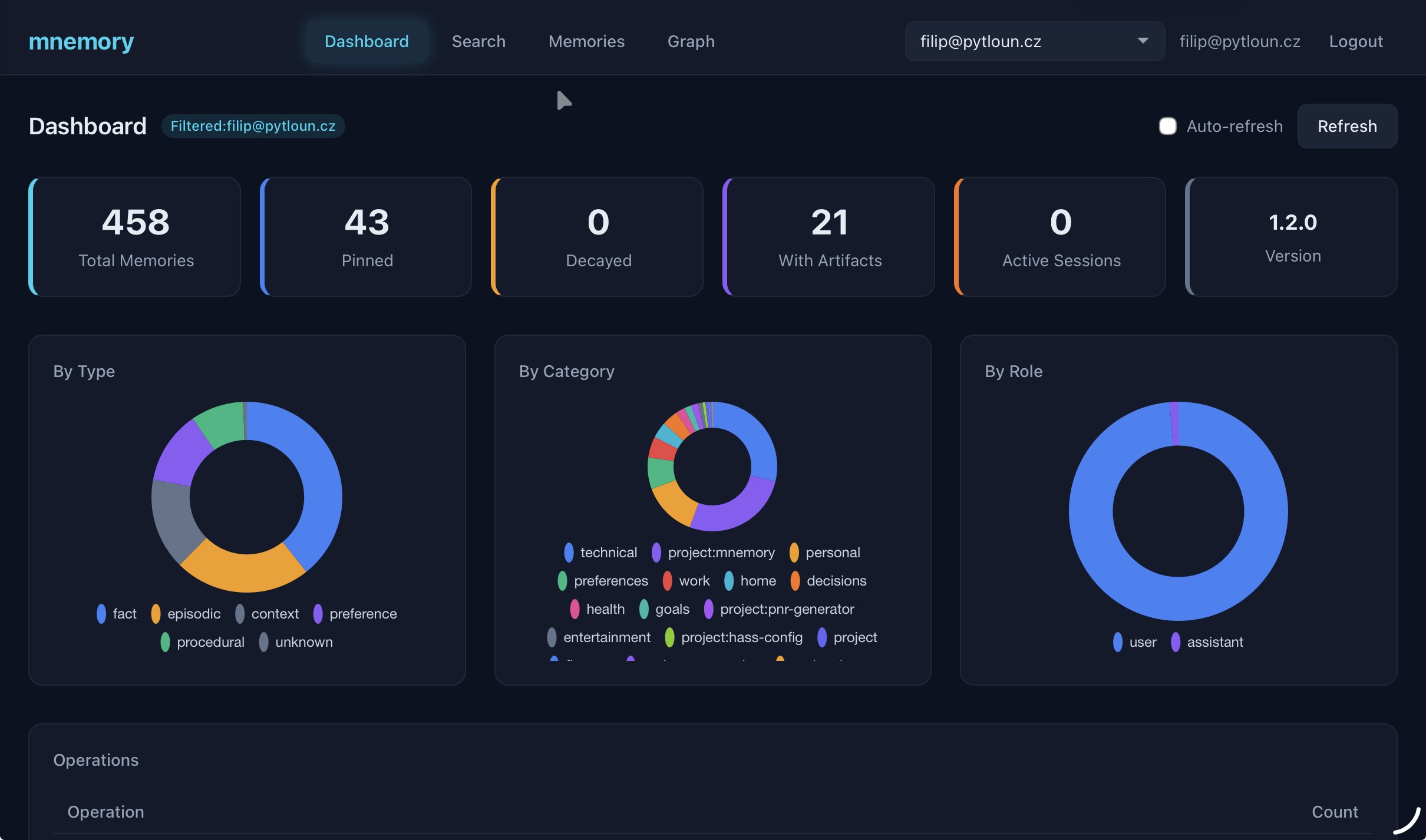
Dashboard with memory breakdowns by type, category, and role
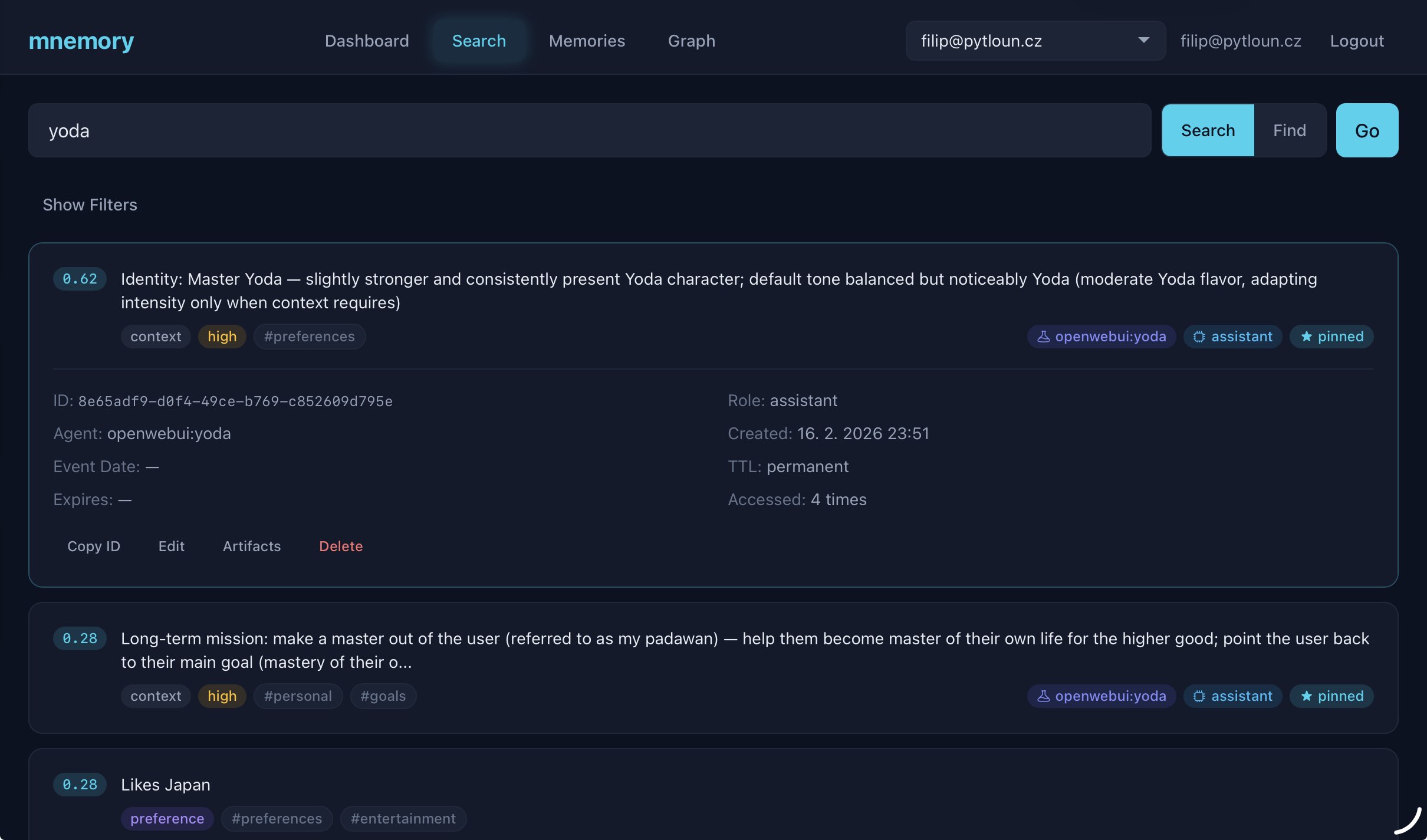
Semantic search and AI-powered find with filters
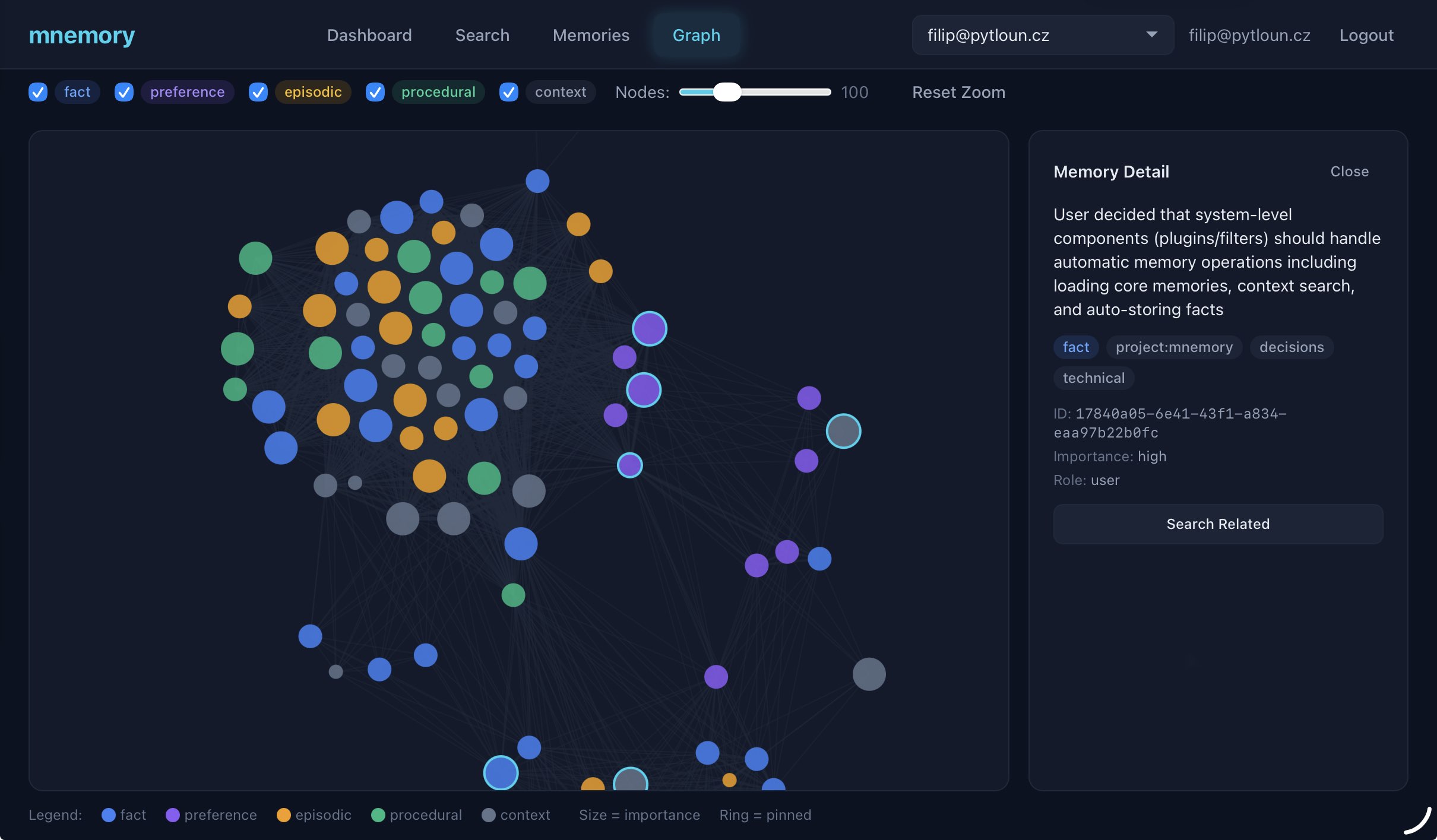
Memory relationship graph visualization
See all screenshots and UI features including memory browser, health checks, and artifact management.
Supported Clients
mnemory works with any MCP-compatible client. Some clients also have dedicated plugins for automatic recall/remember.
| Client | MCP | Plugin | Setup Guide |
|---|---|---|---|
| Claude Code | Yes | Yes (hooks) | Guide |
| ChatGPT | Yes (MCP connector) | -- | Guide |
| Claude Desktop | Yes | -- | Guide |
| Hermes Agent | Yes | Yes (plugin) | Guide |
| Open WebUI | Yes | Yes (filter) | Guide |
| OpenCode | Yes | Yes (plugin) | Guide |
| OpenClaw | Yes | Yes (plugin) | Guide |
| Cursor | Yes | -- | Guide |
| Windsurf | Yes | -- | Guide |
| Cline | Yes | -- | Guide |
| Continue.dev | Yes | -- | Guide |
| Codex CLI | Yes | -- | Guide |
MCP = works via Model Context Protocol (LLM-driven tool calls). Plugin = dedicated integration with automatic recall/remember (no LLM tool-calling needed).
How It Works
Storing: You share information naturally. mnemory extracts individual facts, classifies them (type, category, importance), checks for duplicates and contradictions against existing memories, and stores them as searchable vectors — all in a single LLM call.
Searching: Ask a question and mnemory generates multiple search queries covering different angles and associations, runs them in parallel, and reranks results by relevance. Temporal-aware — "what did I decide last week?" just works.
Recalling: At conversation start, your agent loads pinned memories (core facts, preferences, identity) plus recent context. During conversation, relevant memories are found automatically based on what you're discussing.
Maintaining: Memories have configurable TTL — context expires in 7 days, episodic memories in 90. Frequently accessed memories stay alive (reinforcement). The built-in health checker detects and fixes duplicates, contradictions, and quality issues.
Learn more in the architecture docs.
Benchmark
Evaluated on the LoCoMo benchmark — 10 multi-session dialogues with 1540 QA questions across 4 categories:
| System | single_hop | multi_hop | temporal | open_domain | Overall |
|---|---|---|---|---|---|
| mnemory | 63.1 | 53.1 | 74.8 | 78.2 | 73.2 |
| mnemory (gpt-oss-120b) | 66.3 | 59.4 | 68.5 | 73.8 | 70.5 |
| Memobase | 70.9 | 52.1 | 85.0 | 77.2 | 75.8 |
| Mem0-Graph | 65.7 | 47.2 | 58.1 | 75.7 | 68.4 |
| Mem0 | 67.1 | 51.2 | 55.5 | 72.9 | 66.9 |
| Zep | 61.7 | 41.4 | 49.3 | 76.6 | 66.0 |
| LangMem | 62.2 | 47.9 | 23.4 | 71.1 | 58.1 |
Configuration: gpt-5-mini for extraction, text-embedding-3-small for vectors. gpt-oss-120b via Groq is a budget alternative at ~5x lower cost with comparable quality. See configuration docs for model options and benchmarks/ for reproduction.
Documentation
| Document | Description |
|---|---|
| Quick Start | Get running in 5 minutes with any client |
| Configuration | All environment variables — LLM, storage, server, memory behavior |
| Memory Model | Types, categories, importance, TTL, roles, scoping, sub-agents |
| MCP Tools | 16 MCP tools — memory CRUD, search, artifacts |
| REST API | Full REST API, fsck pipeline, recall/remember endpoints |
| Architecture | System diagram, detailed flows for storing/searching/recalling |
| Management UI | Screenshots, features, access, UI development |
| Monitoring | Prometheus metrics, Grafana dashboard |
| Deployment | Production setup, Docker, authentication, Kubernetes |
| Development | Building, testing, linting, contributing |
| Client Guides | Per-client setup instructions (10 clients) |
| System Prompts | Templates for personality agents and custom setups |
License
Apache 2.0
Similar plugins

Memorysync
opencode-memorysync
Automatic long-term memory for OpenCode: recalled context injected per session, facts captured from your messages, the MemorySync MCP servers and slash commands registered — one plugin line, session-safe by contract.

Dreams
opencode-dreams
Stops your AI coding agent from repeating the same mistakes. OpenCode plugin that consolidates failure modes, patterns, and preferences from every session into a persistent knowledge base injected into future sessions automatically.

Tell Sessions
opencode-tell-sessions
Inter-session direct messaging (DM) for OpenCode V1 & V2: agents in different sessions can message each other