
2
235
近 7 天 39
37.2
生态多维模型
29 天前
2026-07-21
快速安装与配置
opencode.json写入当前项目的 opencode.json,只对这个仓库生效。
opencode.json
{
  "$schema": "https://opencode.ai/config.json",
  "plugin": ["@qdang46/opencode-dcp-plugin@1.0.0"]
}
写入 ~/.config/opencode/opencode.json,对所有项目生效。
~/.config/opencode/opencode.json
{
  "$schema": "https://opencode.ai/config.json",
  "plugin": ["@qdang46/opencode-dcp-plugin@1.0.0"]
}
若你要在本地改造这个插件,先装到项目里再从本地路径引用。
shell
pnpm add -D @qdang46/opencode-dcp-pluginopencode 启动时会通过内嵌运行时自动加载 npm 依赖并缓存至本地目录,无需手动在全局环境执行安装。
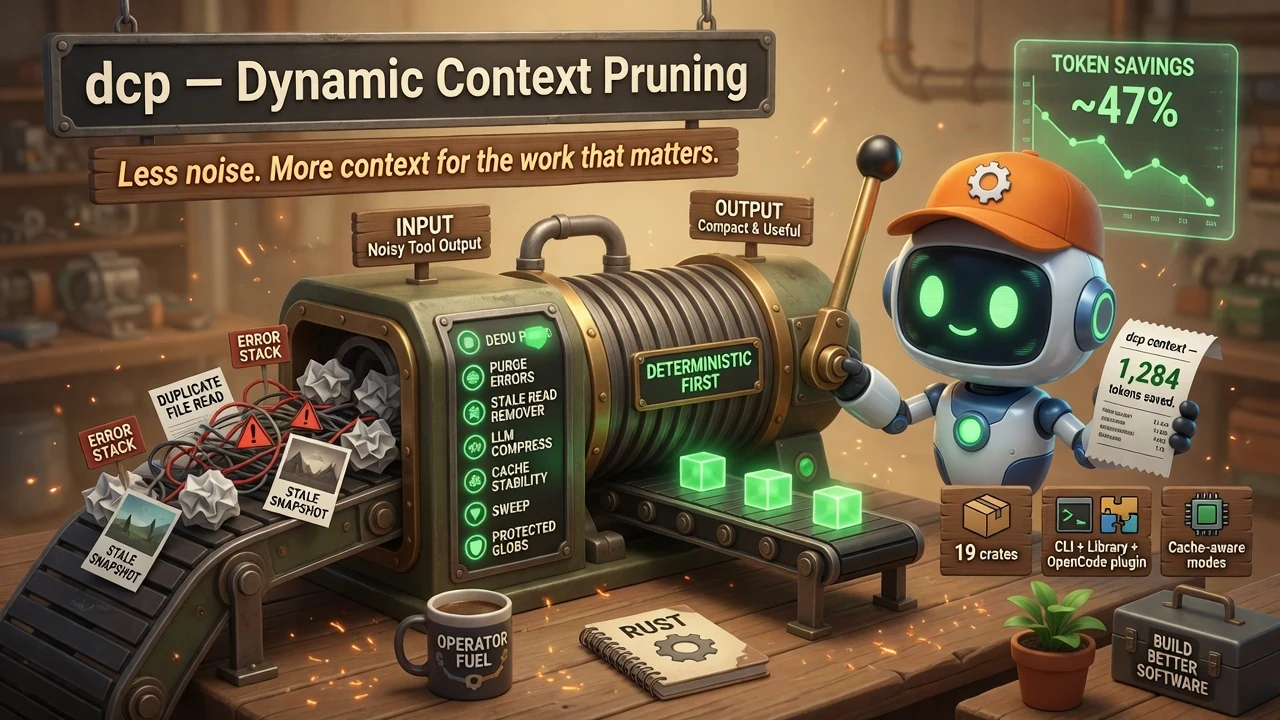




Deterministic + LLM-driven context pruning for coding agents.
Shrink session token load with dedup, error purge, stale-read removal, and optional LLM compression — via library embed or OpenCode plugin.
🤖 Agent Quickstart (Robot Mode)
use dcp_config::Config;
use dcp_core::ContextPruner;

let pruner = ContextPruner::builder()
    .config(Config::load_default()?)
    .build()?;
let pruned = pruner.transform_messages(messages)?;
Or as OpenCode plugin — /dcp opens the prune panel:
| Slash | Action |
|---|---|
/dcp |
Open panel |
/dcp context |
Token breakdown |
/dcp stats |
Prune stats |
/dcp sweep |
Flush pending strategies |
/dcp decompress <id> |
Restore a block |
/dcp recompress <id> |
Re-activate a block |
/dcp-compress [focus] |
Manual compression |
TL;DR
The Problem
Long agent sessions fill context with noise:
| Noise | Cost |
|---|---|
| Duplicate tool results | Tokens for the same file twice |
| Stale file reads | Old snapshots after later edits |
| Error dumps already fixed | Dead stack traces |
| Unstructured history | Cache thrash + higher latency |
The Solution
dcp prunes first with deterministic strategies, then optionally LLM-compresses ranges while tracking blocks for cache stability.
| Surface | What you get |
|---|---|
Library (dcp-core) |
Embed ContextPruner in your agent |
| OpenCode plugin | Real-time prune panel + slash commands |
Why Use dcp?
| Feature | What it does |
|---|---|
| Deterministic first | Dedup, purge errors, drop stale file reads — no model required |
| Optional LLM compress | Range / message modes with block bookkeeping |
| Cache-aware modes | aggressive · agent-message · manual stability modes |
| Protected globs | Never prune secrets (e.g. **/.env) |
| Agent-native surfaces | Library + OpenCode plugin |
| JSON robot output | Scriptable analytics for agent loops |
Quick Example
use dcp_config::Config;
use dcp_core::ContextPruner;

let pruner = ContextPruner::builder()
    .config(Config::load_default()?)
    .build()?;

// Deterministic strategies run automatically on transform
let pruned = pruner
    .transform_messages(raw_messages)?;

// Optional: LLM compress a range
use dcp_compress::{CompressArgs, RangeEntry};
pruner.handle_compress(
    CompressArgs::Range {
        topic: "session recap".into(),
        content: vec![RangeEntry {
            start_id: first.id.clone(),
            end_id: last.id.clone(),
            summary: "Compress early messages".into(),
        }],
    },
    &pruned,
)?;
Design Philosophy
Deterministic before generative.
Cheap, predictable strategies run first. LLM compression is opt-in and block-tracked.Cache stability is a first-class goal.
Naive "summarize everything" thrashes provider caches. dcp tracks compressible blocks and modes.Never silently destroy protected content.
Glob protection keeps secrets and critical paths out of prune paths.Embeddable, not only a CLI.
dcp-core'sContextPruneris the library facade; plugins are thin surfaces.Degrade cleanly.
No LLM backend configured? Deterministic strategies still run.
How dcp Compares
| Approach | Control | Cache-aware | Agent-native | Restorable blocks |
|---|---|---|---|---|
Manual /clear |
Coarse | No | No | No |
| Summarize-everything | Lossy | Often breaks | Partial | Rarely |
| Provider compact only | Opaque | Varies | Built-in only | Varies |
| dcp | Strategy + blocks | Yes | Library + plugin | Yes |
When to use dcp:
- Long coding-agent sessions with repeated tool reads
- Embedding pruning inside a custom agent runtime
- OpenCode users who want a live prune panel
When dcp might not be ideal:
- Single-turn prompts with tiny context
- Environments where you cannot persist block payloads for decompress
Installation
OpenCode plugin
opencode plugin @qdang46/opencode-dcp-plugin@latest --global
Restart OpenCode → /dcp opens the panel.
From source
git clone https://github.com/quangdang46/dynamic_context_pruning.git
cd dynamic_context_pruning
cargo build --workspace --release
Requires Rust 1.85+ (edition 2024).
As a library
[dependencies]
dcp-core = { git = "https://github.com/quangdang46/dynamic_context_pruning" }
dcp-config = { git = "https://github.com/quangdang46/dynamic_context_pruning" }
use dcp_config::Config;
use dcp_core::ContextPruner;

let cfg = Config::load_default()?;
cfg.validate()?;
let pruner = ContextPruner::builder().config(cfg).build()?;
The same interface is exported via NAPI bindings for Node.js / Python consumers through the OpenCode plugin bridge (opencode-dcp-bridge).
See examples/01_minimal.rs … 06_cache_stability.rs.
Configuration
Later tiers win per key (arrays replace wholesale):
- Built-in defaults
$XDG_CONFIG_HOME/dynamic_context_pruning/config.jsonc$DCP_CONFIG_DIR/config.jsonc.dynamic_context_pruning/config.jsonc(project / ancestor)
{
  "enabled": true,
  // "aggressive" | "agent-message" | "manual"
  "cacheStabilityMode": "agent-message",
  "protectedFilePatterns": ["**/.env"],
  "compress": {
    "mode": "range",
    "maxBlocks": 50,
    "minTokens": 2000
  },
  "strategies": {
    "dedup": { "enabled": true },
    "purgeErrors": { "enabled": true },
    "staleFileReads": { "enabled": true, "maxAge": 3600 }
  },
  "notification": { "level": "essential" }
}
use dcp_config::Config;
let cfg = Config::load_default()?;
cfg.validate()?;
Schema reference: dcp.schema.json.
Architecture
Modular Rust workspace (~18 crates):
dcp-types / dcp-traits
    ├── dcp-tokens          token backends
    ├── dcp-protected       glob protection
    ├── dcp-state           session transitions
    │     ├── dcp-storage
    │     ├── dcp-prune       dedup · purge_errors · stale_file_reads
    │     ├── dcp-compress    LLM range/message modes
    │     └── dcp-nudges
    ├── dcp-config          4-tier cascade
    ├── dcp-core            ContextPruner facade
    └── opencode-dcp-bridge
| Crate | Role |
|---|---|
dcp-core |
Primary library entry (ContextPruner) |
dcp-prune |
Deterministic strategies |
dcp-compress |
LLM compression + block bookkeeping |
dcp-config |
JSONC cascade: builtin → global → custom → project |
opencode-dcp-bridge |
OpenCode plugin bridge (NAPI bindings) |
Testing
cargo test --workspace
cargo test -p dcp-core
| Kind | Where |
|---|---|
| Unit | Inline #[cfg(test)] |
| Property | dcp-state + proptest |
| Snapshot | insta |
| Examples | examples/01_minimal.rs … 06_cache_stability.rs |
Troubleshooting
OpenCode panel missing
opencode plugin @qdang46/opencode-dcp-plugin@latest --global
# fully restart OpenCode, then:
/dcp
Decompress cannot restore a block
Blocks are tracked; restore depends on the persistence backend still holding the payload. If the block was GC'd or storage was wiped, compress from source messages instead.
Library usage questions
Check the examples under examples/ or open an issue on GitHub.
CLI predecessors
This project was originally distributed as a standalone CLI binary. That binary has been removed; the library and OpenCode plugin are the supported surfaces going forward. If you need the CLI, pin to an earlier release.
Limitations
What dcp Doesn't Do (Yet)
- Not a full agent runtime — prunes context; does not replace the agent loop
- LLM compress quality depends on the model you wire in
- Wrong cache mode can still thrash provider caches if misconfigured
Known Limitations
| Capability | Current state | Notes |
|---|---|---|
| Deterministic-only mode | ✅ | Disable compress / leave LLM unconfigured |
| Pixel-perfect memory of every byte | ⚠️ Block-based | Decompress needs persisted payload |
| Multi-agent shared store | ⚠️ | Design for single-session storage first |
FAQ
Deterministic only?
Yes — disable compress strategies / leave LLM backends unconfigured; dedup + purge + stale-read still run.
Is OpenCode required?
No. The library (dcp-core) works standalone.
Does decompress always restore originals?
Blocks are tracked; restore depends on the persistence backend still holding the payload.
How do I protect secrets?
Set protectedFilePatterns in config (e.g. **/.env, **/credentials.json).
Can I embed this in my own agent?
Yes — use dcp-core's ContextPruner and the examples under examples/.
What is cacheStabilityMode?
Controls how aggressively compressed ranges are allowed to invalidate provider prompt caches. Prefer agent-message unless you know you need aggressive or full manual control.
Are there Node.js / Python bindings?
Yes — the opencode-dcp-bridge crate exports NAPI bindings consumed by the OpenCode plugin, and the same interface can be used from Node.js or Python.
About Contributions
Please don't take this the wrong way, but I do not accept outside contributions for any of my projects. I simply don't have the mental bandwidth to review anything, and it's my name on the thing, so I'm responsible for any problems it causes; thus, the risk-reward is highly asymmetric from my perspective. I'd also have to worry about other "stakeholders," which seems unwise for tools I mostly make for myself for free. Feel free to submit issues, and even PRs if you want to illustrate a proposed fix, but know I won't merge them directly. Instead, I'll have Claude or Codex review submissions via gh and independently decide whether and how to address them. Bug reports in particular are welcome. Sorry if this offends, but I want to avoid wasted time and hurt feelings. I understand this isn't in sync with the prevailing open-source ethos that seeks community contributions, but it's the only way I can move at this velocity and keep my sanity.
License
Less noise. More context for the work that matters.