
Cli Enforcer
OpenCode plugin for resilient multi-LLM CLI orchestration (Claude, Gemini, Codex) with circuit breaker, retry, fallback, and cross-platform support
0
31
近 7 天 3
20.3
生态多维模型
5 个月前
2026-04-20
快速安装与配置
opencode.json写入当前项目的 opencode.json,只对这个仓库生效。
opencode.json
{
  "$schema": "https://opencode.ai/config.json",
  "plugin": ["opencode-cli-enforcer@1.3.0"]
}
写入 ~/.config/opencode/opencode.json,对所有项目生效。
~/.config/opencode/opencode.json
{
  "$schema": "https://opencode.ai/config.json",
  "plugin": ["opencode-cli-enforcer@1.3.0"]
}
若你要在本地改造这个插件,先装到项目里再从本地路径引用。
shell
pnpm add -D opencode-cli-enforcerOpenCode 启动时会通过内嵌运行时自动加载 npm 依赖并缓存至本地目录,无需手动在全局环境执行安装。

opencode-cli-enforcer
Resilient multi-LLM CLI orchestration for OpenCode
Execute Claude, Gemini & Codex with circuit breakers, smart retry, automatic fallback, and role-based routing.




Why opencode-cli-enforcer?
Running AI CLIs in production is fragile. Processes timeout, rate limits hit, binaries disappear. Calling three different CLIs means three different failure modes, arg formats, and platform quirks.
opencode-cli-enforcer wraps all of that into a single, resilient plugin:
Without this plugin
|
With this plugin
|
Architecture
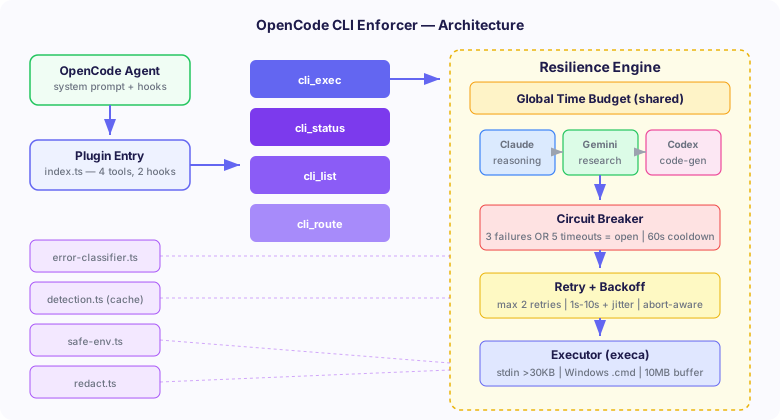
cli_exec(prompt)
  |
  v
+----------------------------------------------------------+
|                  Resilience Engine                        |
|                                                          |
|  Global Time Budget (shared across ALL attempts)         |
|  +---------+     +---------+     +---------+             |
|  | Claude  | --> | Gemini  | --> | Codex   |  fallback   |
|  +---------+     +---------+     +---------+  chain      |
|       |               |               |                  |
|       v               v               v                  |
|  [Circuit Breaker] -----> [Retry w/ Backoff] --> [execa] |
|  3 failures = open        max 2 retries          10MB    |
|  5 timeouts = open        1s-10s + jitter        buffer  |
|  60s cooldown             abort-aware sleep               |
+----------------------------------------------------------+
Quick Start
1. Install as OpenCode plugin (recommended)
Add to your OpenCode configuration:
{
  "plugin": ["opencode-cli-enforcer@latest"]
}
2. Install via npm / bun
bun add opencode-cli-enforcer
# or
npm install opencode-cli-enforcer
3. Prerequisites
You need at least one CLI installed and authenticated:
| CLI | Install | Auth |
|---|---|---|
| Claude Code | npm i -g @anthropic-ai/claude-code |
claude login |
| Gemini CLI | npm i -g @anthropic-ai/gemini-cli |
gcloud auth login |
| Codex CLI | npm i -g @openai/codex |
codex auth |
Tools Reference
cli_exec — Execute with full resilience
The primary tool. Sends a prompt to a CLI with automatic retry, circuit breaker protection, and fallback.
cli_exec({
  cli: "claude",
  prompt: "Explain the observer pattern with a TypeScript example",
  mode: "generate",           // "generate" | "analyze"
  timeout_seconds: 300,       // Global budget: 10-1800s
  allow_fallback: true        // Try gemini/codex on failure
})
| Parameter | Type | Default | Description |
|---|---|---|---|
cli |
"claude" | "gemini" | "codex" |
required | Primary CLI provider |
prompt |
string |
required | Prompt to send (max 100KB) |
mode |
"generate" | "analyze" |
"generate" |
analyze enables file reads (Claude only) |
timeout_seconds |
number |
720 |
Global timeout budget in seconds |
allow_fallback |
boolean |
true |
Auto-fallback to alternative providers |
Response:
{
  "success": true,
  "cli": "claude",
  "stdout": "The Observer pattern is a behavioral design pattern...",
  "stderr": "",
  "duration_ms": 4523,
  "timed_out": false,
  "used_fallback": false,
  "fallback_chain": ["claude"],
  "error": null,
  "error_class": null,           // "transient" | "rate_limit" | "permanent" | "crash"
  "circuit_state": "closed",     // "closed" | "open" | "half-open"
  "attempt": 1,
  "max_attempts": 3
}
cli_status — Health dashboard
Returns real-time health for all providers: installation status, circuit breaker state, and usage statistics.
cli_status({})
Response:
{
  "platform": "windows",
  "detection_complete": true,
  "retry_config": { "max_retries": 2, "base_delay_ms": 1000, "max_delay_ms": 10000 },
  "breaker_config": { "failure_threshold": 3, "timeout_threshold": 5, "cooldown_seconds": 60 },
  "providers": [
    {
      "name": "claude",
      "installed": true,
      "path": "/usr/local/bin/claude",
      "version": "1.0.16",
      "circuit_breaker": {
        "state": "closed",
        "consecutive_failures": 0,
        "consecutive_timeouts": 0,
        "total_executions": 12,
        "total_failures": 1,
        "total_timeouts": 0
      },
      "usage": {
        "total_calls": 12,
        "success_rate": "92%",
        "avg_duration_ms": 3400
      },
      "fallback_order": ["gemini", "codex"]
    }
    // ... gemini, codex
  ]
}
cli_list — List installed providers
Quick check of which CLIs are available on the system.
cli_list({})
Response:
{
  "installed_count": 2,
  "providers": [
    { "provider": "claude", "path": "/usr/local/bin/claude", "version": "1.0.16", "strengths": ["reasoning", "code-analysis", "debugging", "architecture", "planning"] },
    { "provider": "gemini", "path": "/usr/local/bin/gemini", "version": "0.1.8", "strengths": ["research", "trends", "knowledge", "large-context", "web-search"] }
  ]
}
cli_route — Role-based routing
Recommends the best CLI for a task based on agent role. Considers both provider strengths and real-time availability.
cli_route({
  role: "developer",
  task_description: "Refactor the auth module to use JWT"
})
| Parameter | Type | Description |
|---|---|---|
role |
"manager" | "coordinator" | "developer" | "researcher" | "reviewer" | "architect" |
Agent role |
task_description |
string? |
Optional context |
Routing table:
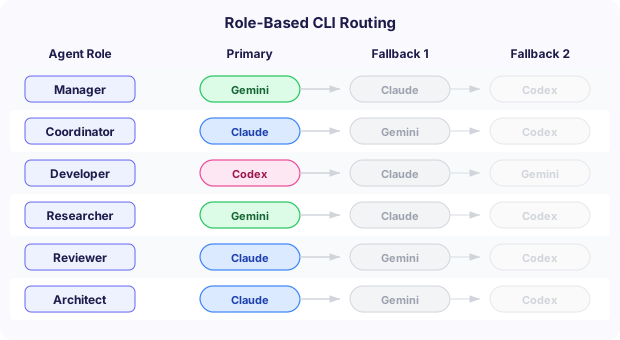
| Role | Primary CLI | Reasoning |
|---|---|---|
| Manager | Gemini | Research, trends, large-context analysis |
| Coordinator | Claude | Reasoning, planning, decision-making |
| Developer | Codex | Code generation, refactoring, full-auto |
| Researcher | Gemini | Knowledge synthesis, web search |
| Reviewer | Claude | Code analysis, debugging, quality |
| Architect | Claude | System design, architecture planning |
Response:
{
  "role": "developer",
  "task_description": "Refactor the auth module to use JWT",
  "recommended_cli": "codex",
  "reasoning": "Role \"developer\" maps to codex (code-generation, edits, refactoring, full-auto).",
  "fallback_chain": ["codex", "claude", "gemini"],
  "availability": { "codex": true, "claude": true, "gemini": false }
}
Resilience Pipeline
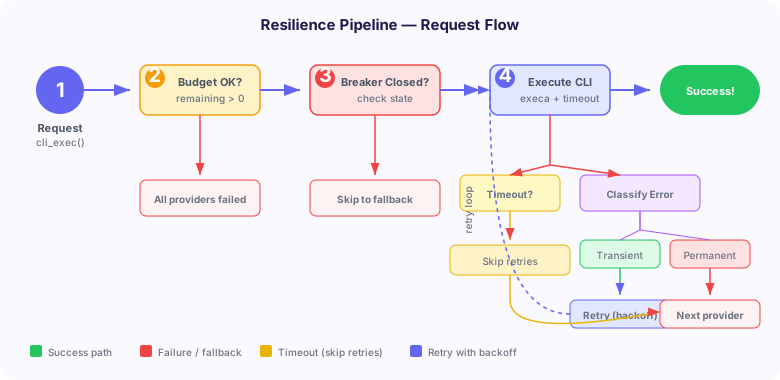
Global Time Budget
Unlike per-attempt timeouts, the global time budget is shared across ALL retries and ALL fallback providers. This prevents timeout multiplication:
Traditional:  3 providers x 3 attempts x 300s timeout = 2700s worst case
This plugin:  300s total budget across everything       =  300s worst case
Each attempt receives the remaining seconds, not the full budget. When the budget runs out, execution stops immediately.
Circuit Breaker
Per-CLI failure isolation with separate thresholds for failures and timeouts (because slow ≠ broken):
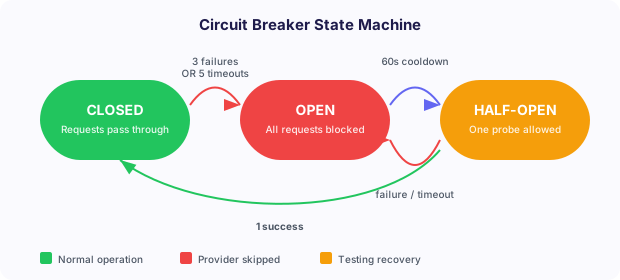
| State | Behavior | Transition |
|---|---|---|
| Closed | Normal operation, requests pass through | 3 failures OR 5 timeouts → Open |
| Open | All requests blocked, provider is skipped | After 60s cooldown → Half-Open |
| Half-Open | One probe request allowed | Success → Closed / Failure → Open |
Retry with Exponential Backoff
Attempt 0:  immediate
Attempt 1:  ~1s  + jitter (+-30%)
Attempt 2:  ~2s  + jitter (+-30%)
            capped at 10s max
- Transient errors (network, socket): standard retry
- Rate limits (429, quota): retry with 3x longer delay
- Process timeouts: skip retries entirely, move to next provider
- Permanent errors (auth, 401/403): skip retries, move to fallback
- Crash (SIGKILL, ENOENT): skip retries, move to fallback
Error Classification
Error arrives
  |
  +-- exitCode 137 / SIGKILL / ENOENT ---------> CRASH      (no retry)
  +-- 429 / "rate limit" / "quota" -------------> RATE_LIMIT (retry, 3x delay)
  +-- 401 / 403 / "auth" / "not found" --------> PERMANENT  (no retry)
  +-- everything else --------------------------> TRANSIENT  (retry)
Fallback Chain
When a provider fails, the next one in the chain takes over automatically:
Claude ---[fail]---> Gemini ---[fail]---> Codex
Gemini ---[fail]---> Claude ---[fail]---> Codex
Codex  ---[fail]---> Claude ---[fail]---> Gemini
Cross-Platform Support
| Feature | Windows | macOS / Linux |
|---|---|---|
| Binary detection | where |
which |
.cmd/.bat shims |
Auto-wrapped with cmd /c |
N/A |
| PATH augmentation | npm, scoop, cargo, pnpm dirs | Standard PATH |
| Large prompts (>30KB) | Delivered via stdin to avoid OS arg-length limits |
|
| Environment | Allowlisted vars only (no secrets leak to subprocesses) |
Detection Caching
CLI availability is cached for 5 minutes to avoid repeated filesystem lookups. The cache covers:
- Binary path resolution
- Version detection
- Both positive and negative results
Security
| Protection | Description |
|---|---|
| Secret redaction | API keys (sk-*, key-*, AIza*, ant-api*) and Bearer tokens stripped from all output |
| Environment filtering | Only system essentials + proxy vars passed to subprocesses. No API keys — CLIs handle their own auth. |
| Input isolation | Large prompts (>30KB) delivered via stdin, not shell args |
| No shell interpolation | All CLI execution via execa (no shell: true) |
Examples
Basic: Ask Claude to review code
const result = await cli_exec({
  cli: "claude",
  prompt: "Review this function for bugs:\n\nfunction add(a, b) { return a - b }",
  mode: "analyze",
  timeout_seconds: 120
})
// result.stdout → "Bug found: the function is named `add` but performs subtraction..."
Fallback: Primary CLI is down
// Claude's circuit breaker is open (too many recent failures)
const result = await cli_exec({
  cli: "claude",
  prompt: "Generate a REST API for user management",
  allow_fallback: true
})
// result.cli → "gemini" (automatic fallback)
// result.used_fallback → true
Role routing: Pick the right tool for the job
// For a developer task, route to Codex (best at code generation)
const recommendation = await cli_route({
  role: "developer",
  task_description: "Implement pagination for the /users endpoint"
})
// recommendation.recommended_cli → "codex"

// Then execute with the recommended CLI
const result = await cli_exec({
  cli: recommendation.recommended_cli,
  prompt: "Implement pagination for the /users endpoint using cursor-based pagination"
})
Monitor health across providers
const status = await cli_status({})

for (const provider of status.providers) {
  console.log(`${provider.name}: ${provider.circuit_breaker.state} | ${provider.usage.success_rate}`)
}
// claude: closed | 95%
// gemini: closed | 88%
// codex: open   | 60%  <-- circuit breaker tripped
Large prompt via stdin
const largeCodebase = readFileSync("src/index.ts", "utf-8") // 45KB file
const result = await cli_exec({
  cli: "claude",
  prompt: `Analyze this codebase for security vulnerabilities:\n\n${largeCodebase}`,
  mode: "analyze",
  timeout_seconds: 600
})
// Prompt >30KB → automatically delivered via stdin (no OS arg-length issues)
Hooks
The plugin injects two hooks into the OpenCode lifecycle:
experimental.chat.system.transform
Automatically injects CLI availability into the system prompt of every agent (except orchestrator and task_decomposer), so the LLM knows which tools are available and their current health.
tool.execute.after
Tracks when agents invoke CLIs directly via bash instead of using cli_exec, incrementing usage counters for observability.
Provider Strengths

| Provider | Binary | Strengths |
|---|---|---|
| Claude | claude |
Reasoning, code analysis, debugging, architecture, planning |
| Gemini | gemini |
Research, trends, knowledge, large-context, web search |
| Codex | codex |
Code generation, edits, refactoring, full-auto mode |
Configuration Reference
Circuit Breaker Defaults
| Parameter | Value | Description |
|---|---|---|
failureThreshold |
3 |
Consecutive failures before opening |
timeoutThreshold |
5 |
Consecutive timeouts before opening (slow ≠ broken) |
cooldownMs |
60000 |
Milliseconds before open → half-open |
halfOpenSuccessThreshold |
1 |
Successes in half-open to close |
Retry Defaults
| Parameter | Value | Description |
|---|---|---|
maxRetries |
2 |
Maximum retry attempts per provider |
baseDelayMs |
1000 |
Base delay for exponential backoff |
maxDelayMs |
10000 |
Maximum delay cap |
jitterFactor |
0.3 |
Random jitter range (+-30%) |
Executor Defaults
| Parameter | Value | Description |
|---|---|---|
STDIN_THRESHOLD |
30000 |
Characters before switching to stdin delivery |
MAX_BUFFER |
10MB |
Maximum stdout/stderr buffer |
Development
bun install              # Install dependencies
bun test                 # Run all tests (85 tests)
bun test --watch         # Watch mode
bun test tests/retry.test.ts  # Run a single test file
bun run typecheck        # Type-check without emitting
bun run build            # Build
Project Structure
src/
  index.ts             Plugin entry, 4 tools, 2 hooks
  resilience.ts        Global time budget, retry + breaker + fallback
  circuit-breaker.ts   Per-CLI state machine (failures + timeouts)
  executor.ts          execa wrapper, Windows handling, PATH augmentation
  cli-defs.ts          Provider configs, arg builders, role routing
  detection.ts         CLI auto-detection with 5-min cache
  retry.ts             Exponential backoff, abort-aware sleep
  error-classifier.ts  Error categorization for retry decisions
  safe-env.ts          Environment variable allowlist
  redact.ts            Secret redaction
  platform.ts          OS detection

tests/
  8 test files, 85 tests covering all modules
Contributing
- Fork the repo
- Create a feature branch from
develop:git checkout -b feat/my-feature develop - Make your changes and add tests
- Run
bun test(all 85 must pass) - Open a PR to
develop
License
同类生态推荐

Ocm
@wntic/ocm
Plugin marketplace for opencode: install skills, agents, commands, JS plugins and MCP servers from any git repo — once, globally, kept up to date

Magic Compact
magic-compact
Lossless context compression plugin for OpenCode.

Matrixx
opencode-matrixx
The Best AI Agent Harness - Batteries-Included OpenCode Plugin with Multi-Model Orchestration, Parallel Background Agents, and Crafted LSP/AST Tools