
opencode-artifactsPublish OpenCode session output as self-contained, interactive HTML artifact pages.
1
767
近 7 天 767
40.2
生态多维模型
1 天前
2026-08-19
快速安装与配置
opencode.json写入当前项目的 opencode.json,只对这个仓库生效。
opencode.json
{
  "$schema": "https://opencode.ai/config.json",
  "plugin": ["opencode-artifacts@0.14.4"]
}
写入 ~/.config/opencode/opencode.json,对所有项目生效。
~/.config/opencode/opencode.json
{
  "$schema": "https://opencode.ai/config.json",
  "plugin": ["opencode-artifacts@0.14.4"]
}
若你要在本地改造这个插件,先装到项目里再从本地路径引用。
shell
pnpm add -D opencode-artifactsopencode 启动时会通过内嵌运行时自动加载 npm 依赖并缓存至本地目录,无需手动在全局环境执行安装。
Publish OpenCode session output as self-contained, interactive HTML artifact pages.
Status: public preview. The project is publicly inspectable but currently unsupported and uncertified. There are zero fully supported platform/browser cells, and no representative- user first-use or comprehension baseline is claimed. Exact technical and supply-chain evidence is linked below.


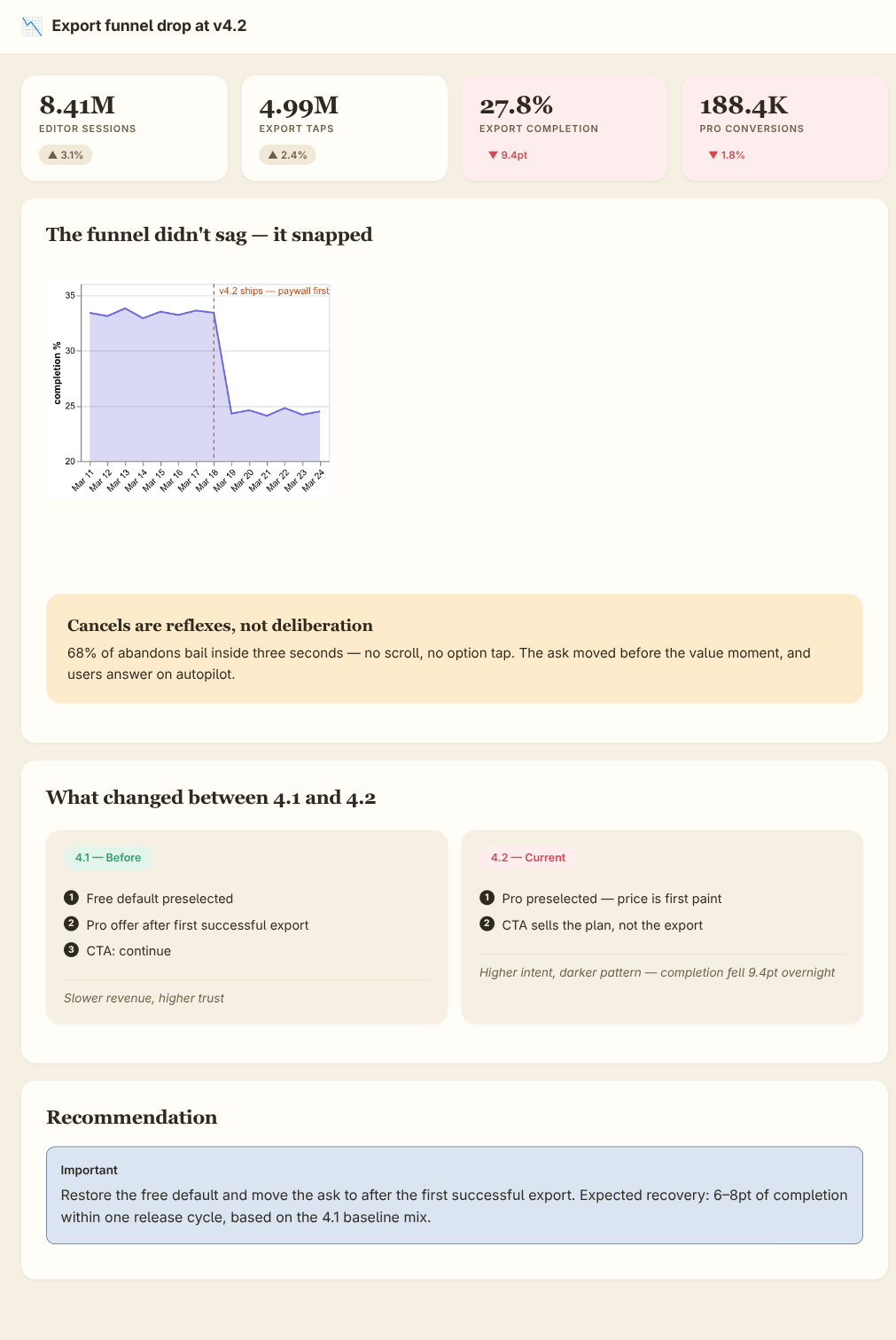
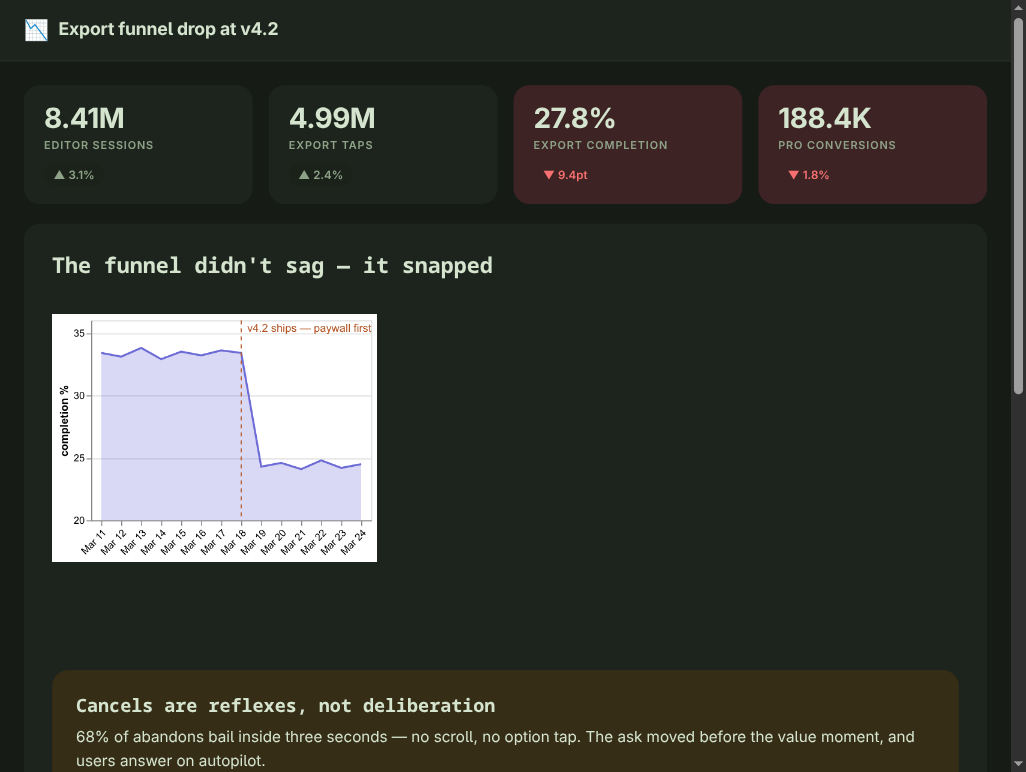
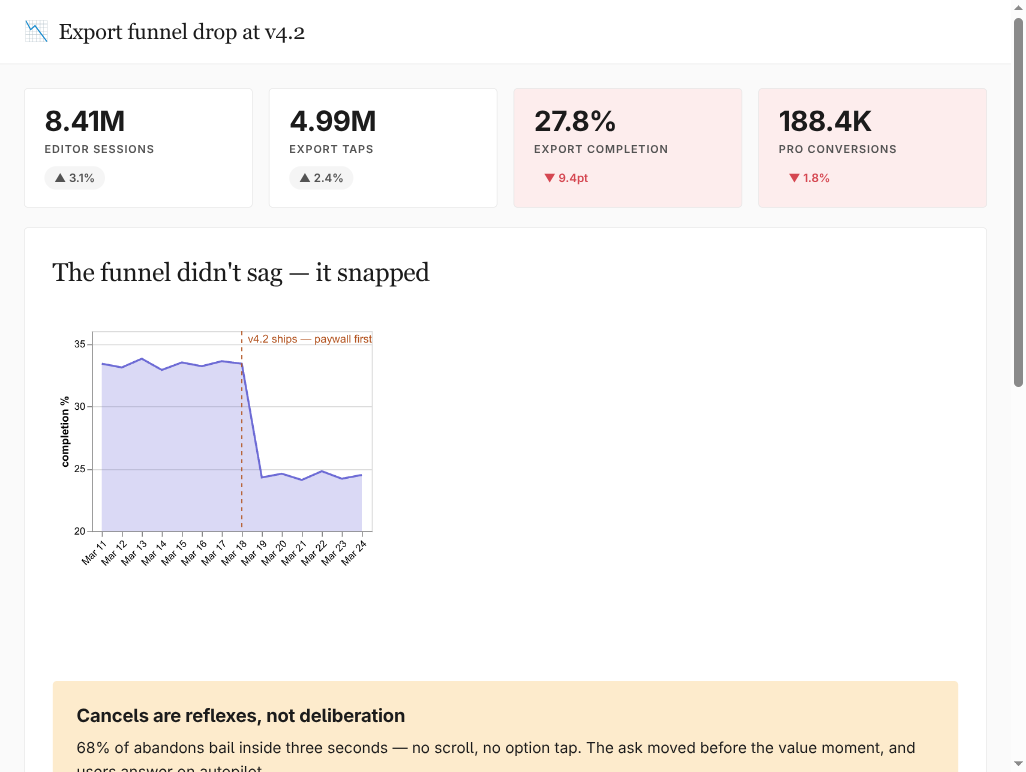
One Markdown source, four curated looks — the same page in ops and editorial:
 |
 |
More verified pages — dashboard, incident, PR walkthrough, checklist, compare, workshop,
tuning playground — in docs/evidence/patterns/, each rendered
from examples/patterns/ and browser-tested with zero console errors.
Inspired by Claude Code Artifacts, rebuilt as a local-first, open-source OpenCode plugin. The model writes Markdown + JSON specs; a fixed renderer owns the HTML/CSS, so page quality doesn't depend on the model's design skills and output stays diff-friendly and cheap in tokens.
Contents
- Features
- Install
- Usage
- Authoring format
- Sharing and hosting
- Limitations
- Governance and support
- Development
- Product specification
- Roadmap
- Parity with Claude Code Artifacts
- Contributing
- License
Features
- Dashboards, PR walkthroughs, incident timelines, checklists, comparisons — component fences (
stats,timeline,findings,compare,callout,progress,diff,copy,mermaid,decisions,table) plus Vega-Lite / Vega / ECharts / Mermaid charts, all inlined into one strict-CSP file - Interactive data tables: the
tablefence gives you sortable, filterable, number-formatted tables with row counts — license-audit example - Provenance on every page: frontmatter
source:lands in the footer asData: … - Curated themes: frontmatter
theme: report | ops | editorialrestyles the whole page — one source, three identities; unnamed pages follow system dark/light with a three-state header toggle - Gallery + versions: every publish updates
.opencode/artifacts/index.html;version: truekeeps numbered history;restorerolls back; a stale-version hash guard prevents blind overwrites - Interactive: chart-bound controls (vega-lite
params.bind, echartsdataZoom), text-selection comments, workshop decision pages the session can read back - Live reload:
opencode-artifacts serverefreshes open pages on every republish - Sharing: cost-free public snapshots via GitHub Pages or a user-operated Cloudflare Worker + KV; Cloudflare Access is a manual, unverified perimeter
- Safe by default: no raw HTML passthrough, credential-pattern scan blocks accidental secret leaks, no external requests at view time


Install
opencode plugin opencode-artifacts
Published at npmjs.com/package/opencode-artifacts. The dated provider report verifies provenance for the then-current registry release. The registry trusted-publisher setting and provenance for unreleased candidate bytes remain unverified until post-publish checks; see the support and release policy.
The official OpenCode plugin command installs the package and updates the project config.
Alternatively, add the npm package directly to opencode.json; OpenCode installs npm plugin
dependencies automatically at startup:
{
  "$schema": "https://opencode.ai/config.json",
  "plugin": ["opencode-artifacts"]
}
The file: spec is only for developing this plugin itself (point OpenCode at your checkout
after npm install && npm run build):
{
  "plugin": ["file:///absolute/path/to/opencode-artifacts"]
}
Optional, for hosted deploys — the wizard asks once whether and where to deploy and writes the
answer to .opencode/artifacts.json (--global for all projects):
npx opencode-artifacts init
# non-interactive: npx opencode-artifacts init --yes --target github --repo you/artifacts
Usage
In a session, just ask:
Summarize this incident investigation and publish it as an artifact with a timeline and an error-rate chart.
The agent calls the artifact_publish tool with Markdown like:
---
title: Incident 4172 — Checkout latency spike
icon: 🚨
description: p99 spike traced to a sync fraud-check call
---

```stats
[{ "label": "PEAK P99", "value": "2.6s", "tone": "bad", "emphasis": true }]
```

```vega-lite
{ "data": { "values": [...] }, "mark": "bar", "encoding": { ... } }
```
and gets back Artifact published to <worktree>/.opencode/artifacts/incident-4172-checkout-latency-spike.html.
For proactive behavior (the agent publishes on its own when output suits a page), enable the plugin option:
{
  "plugin": [["opencode-artifacts", { "proactive": true }]]
}
This injects the bundled guidance (adapted from Claude Code's artifact-design skill) into the
session's system context — visible in the plugin source, off by default, and removable by
deleting the option. Alternative for non-plugin environments: cp -r skills/artifact-pages ~/.agents/skills/ (don't use both).
Comment triage at scale: agents/artifact-comment-analyst.md is a read-only subagent that
digests open comment threads into an actionable brief (blocking issues first, with the page's
current wording at each quote). Install with
cp agents/artifact-comment-analyst.md ~/.config/opencode/agent/.
CLI (also usable standalone, npm install -g opencode-artifacts):
opencode-artifacts render page.md --open --version   # render + open + keep version history
opencode-artifacts serve                             # http://127.0.0.1:4173, live reload
opencode-artifacts restore <slug> --version 1        # roll the stable page back
opencode-artifacts latest --open                     # reopen the most recent artifact
opencode-artifacts state <slug>                      # read workshop answers back
Authoring format
Full reference: docs/component-spec.md. Short version:
- Frontmatter:
title,icon(emoji favicon),description(gallery subtitle) - Components (JSON fences):
statsmetric cards,timeline,findings(severity-coded),comparevariant cards,calloutinsight cards,progress,diff(annotated),copy(copy-to-session button),decisions(workshop rows the session reads back viaartifact_state) - Charts/diagrams:
```vega-lite/```vega/```echarts/```mermaidfences; runtimes inline only when used - Markdown extras: GitHub alerts (
> [!WARNING]etc.), task lists, heading anchors,##sections become cards - Broken specs degrade to inline error boxes; the page always ships
Worked examples for every canonical pattern: examples/patterns/ with
browser-verified screenshots in docs/evidence/patterns/.
Sharing and hosting
| Target | Command | You get |
|---|---|---|
| Local files | (default) | .opencode/artifacts/<slug>.html + gallery |
| Live preview | opencode-artifacts serve |
localhost gallery, SSE live reload, comments/decisions/mini-DB persistence |
| GitHub Pages | opencode-artifacts deploy --repo you/artifacts |
public URL per artifact; git history as audit log (live demo) |
| Cloudflare | deploy --target cloudflare --name my-artifacts |
User-operated public-by-default Worker + KV; comments/decisions/DB work hosted; Access is a manual perimeter — guide |
Limitations
- Local-first: without a deploy target, artifacts are files on your machine — no share links
- Viewer-identity MCP data calls (Claude Code's connector model) need hosted infrastructure we don't run; the datasource bridge executes local shell commands only, and only under
serve - Raw per-page JavaScript (drag-drop boards etc.) is only possible in
format: "html"mode, which opts out of the fixed renderer's guarantees - GitHub Pages and an unprotected Workers URL are public snapshots, not Claude-style private sharing. Cloudflare Access is currently a manual deployment prerequisite rather than a verified access policy managed by this package.
- Hosted pages do not yet push new revisions into already-open browsers, and hosted MCP calls do not run through each viewer's identity.
- No complete Node/OpenCode/OS/browser cell currently meets the supported-platform evidence gate. Existing Linux host and CI observations have narrower scopes.
Governance and support
Current public-preview policy is explicit about incomplete certification evidence:
- support and release policy — Node 24 floor, zero currently supported full matrix cells, current-minor fix window, deprecation and D-06 supply chain;
- security model and response and public reporting status — threat boundaries and response process; private vulnerability reporting is enabled and verified;
- data governance — no default local telemetry, mode-specific inventory, operator/controller boundaries, retention/deletion and public abuse handling.
These documents do not turn missing provider, platform, participant, or production evidence into a readiness claim.
Development
npm install
npm test        # node --test, no framework
npm run build   # tsc -> dist/
npm run check   # structural contracts
Behavior changes use the repository-native spec-anchored workflow: risk-scaled proposal/delta packets, human approval, exact validation and verification evidence, and an updated current-behavior spec before archive. The governing decision and alternatives are in ADR 0001.
Product specification
The authoritative target, boundaries, security model, and definition of complete are in
docs/product-spec.md. It is grounded in current official Claude Code
Artifacts and OpenCode documentation and distinguishes portable pages, public snapshots,
authenticated collaboration, and viewer-scoped connectors.
Its MECE requirement families map to delivery phases, owner roles, evidence, release
applicability, and current status in
docs/requirements-traceability.md.
“Equal or better” page quality is a target, not a current claim; the reproducible same-input
comparison and pass thresholds are defined in
docs/page-quality-benchmark.md.
Roadmap
The gap-driven phased plan is docs/roadmap.md. Immediate priorities are
durable artifact identity and unconditional immutable revisions, cross-process/crash-safe
publishing, embedded local assets, and packed-package compatibility tests against OpenCode.
Authenticated sharing and viewer-scoped connectors are later phases with explicit identity,
consistency, permission, and audit gates.
For long-running execution, docs/goal-runbook.md provides the full
ordered /goal sequence, copy-ready objectives, human/external prerequisites, packet
decomposition, stopping conditions, and handoff to the next release level.
Parity with Claude Code Artifacts
The official-doc baseline, implementation comparison, and verified QA log are in
docs/claude-code-comparison.md. Reverse-engineered
inventory is supplemental research, not the source of parity claims.
Clean OpenCode host evidence covers the current
CLI and previously published 0.14.3 package; the
Claude Code host evidence covers a healthy
local 2.1.233 install and its unauthenticated service boundary.
Contributing
Issues and PRs welcome at
github.com/bitgorust/opencode-artifacts.
Please run npm test before submitting; add a test for every behavior change. For anything
visual, attach a browser screenshot. Standard and high-risk behavior changes also follow the
spec-anchored change workflow.
License
MIT © bitgorust. Documentation, examples, retained screenshots, dependency dispositions, and link-only benchmark references are covered by the redistribution inventory.