
@fulcrum-agent-os/opencode-pluginFulcrum Agent OS — opencode plugin. Injects the canonical Fulcrum-first rider into every LLM turn via experimental.chat.system.transform, with SHA-256 integrity verification and session.idle telemetry for silent-failure detection.
2
15
近 7 天 2
28.8
生态多维模型
1 个月前
2026-06-30
快速安装与配置
opencode.json写入当前项目的 opencode.json,只对这个仓库生效。
opencode.json
{
  "$schema": "https://opencode.ai/config.json",
  "plugin": ["@fulcrum-agent-os/opencode-plugin@0.0.6"]
}
写入 ~/.config/opencode/opencode.json,对所有项目生效。
~/.config/opencode/opencode.json
{
  "$schema": "https://opencode.ai/config.json",
  "plugin": ["@fulcrum-agent-os/opencode-plugin@0.0.6"]
}
若你要在本地改造这个插件,先装到项目里再从本地路径引用。
shell
pnpm add -D @fulcrum-agent-os/opencode-pluginopencode 启动时会通过内嵌运行时自动加载 npm 依赖并缓存至本地目录,无需手动在全局环境执行安装。

Fulcrum
Your repo, your work board, your agents — one local-first Agent OS.
A fulcrum is the pivot point of a lever — the supporting structure that turns small effort into large output. Same idea here: small commits land big outcomes through the agents you supervise.
Project management + agent orchestration + docs + memory + a CLI/TUI/Web triad, all running on your machine. PGlite by default; swap in Postgres with one env var. SaaS-ready schema from day one. Online features ship but stay dark behind explicit feature flags until you opt in.





Quick Start · Three Surfaces · How it Works · User Manuals · Acknowledgements
Why Fulcrum
Coding agents are everywhere; the work around them is fragmented. Tickets in Jira, docs in Notion, runs in a sandbox no one watches, memory in a markdown file someone forgot to commit. Fulcrum collapses that into one process you control:
- Local-first by default — your project, your DB, your machine. No telemetry leaves the box unless you flip a flag.
- Three surfaces, one model — Web, CLI, TUI all hit the same NestJS public API. Whatever you do in one is real in the others, immediately.
- Sandbox-first agent runs — agents run inside isolated worktrees + container images, not your dev shell. Powered by Matt Pocock's Sandcastle.
- OpenAI Symphony-compatible —
fulcrum doctorvalidates conformance to the openai/symphony orchestration spec; the work-board → run lifecycle implements its contract. - No vendor lock-in — PGlite for dev, Postgres for prod via
FULCRUM_DATABASE_URL. Same schema both ways.
Quick Start
# 1. clone + install
git clone https://github.com/moabualruz/fulcrum
cd fulcrum
bun install

# 2. spin the stack (3 processes)
cd apps/server && bun run src/index.ts &                              # NestJS public API @ :3000
cd apps/web    && FULCRUM_SERVER_URL=http://localhost:3000 bun run dev # SvelteKit web  @ :5173
bun run apps/tui/src/index.ts                                          # OpenTUI terminal

# 3. install the CLI globally (one binary)
bun run build && cp dist/fulcrum-darwin-arm64 ~/.local/bin/fulcrum
fulcrum doctor   # confirms the stack is wired
Open http://localhost:5173/, pick your project, ship work.
Three Surfaces, One Brain
The same NestJS server backs every surface. The web is a pure invocation
layer — it never opens a database — and the TUI / CLI hit the same /api/v1/*
endpoints. Whatever a human can do, an agent can do.
| Web SvelteKit · :5173 |
CLI Bun-compiled · one binary |
TUI OpenTUI · keyboard-first |
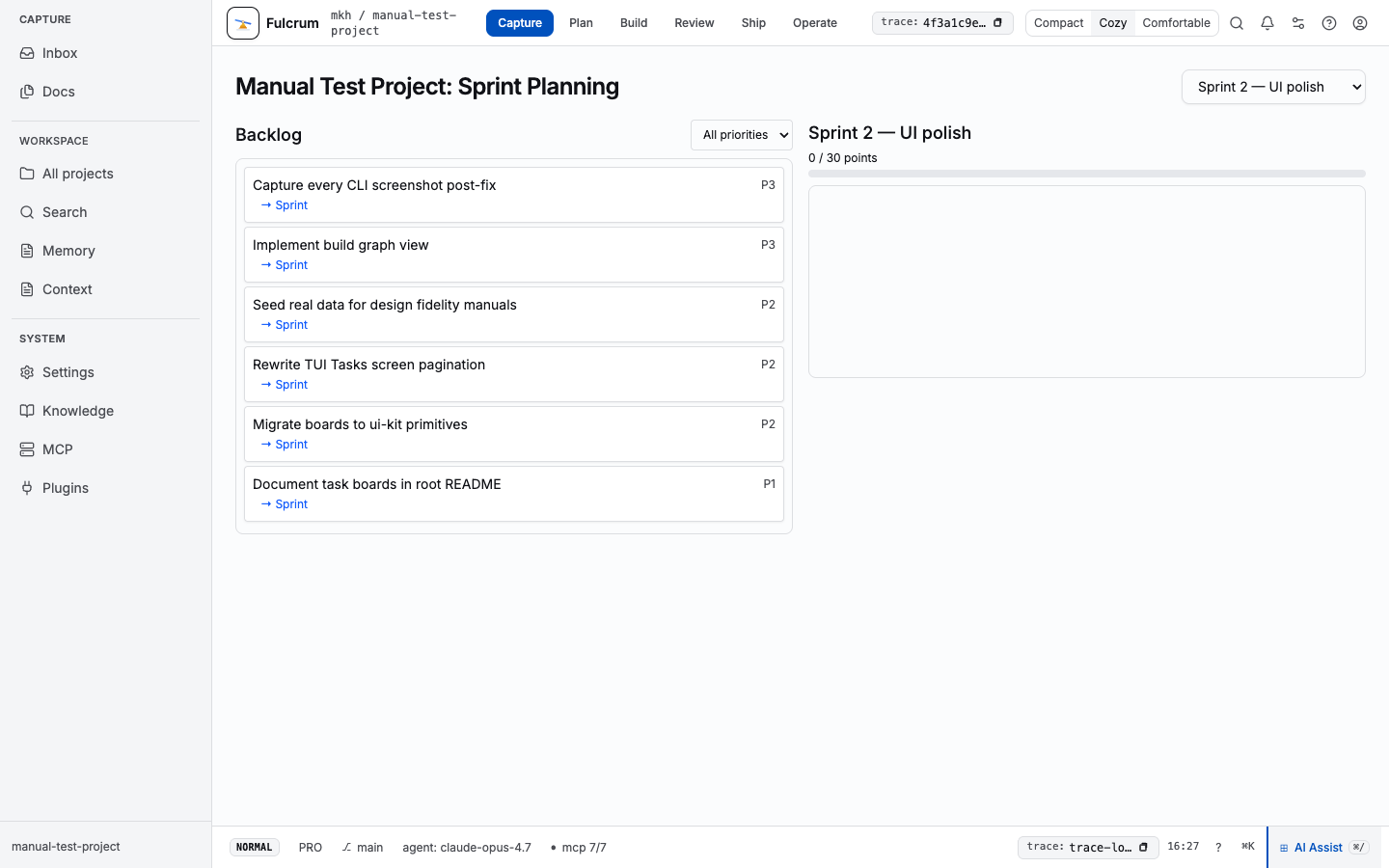 |
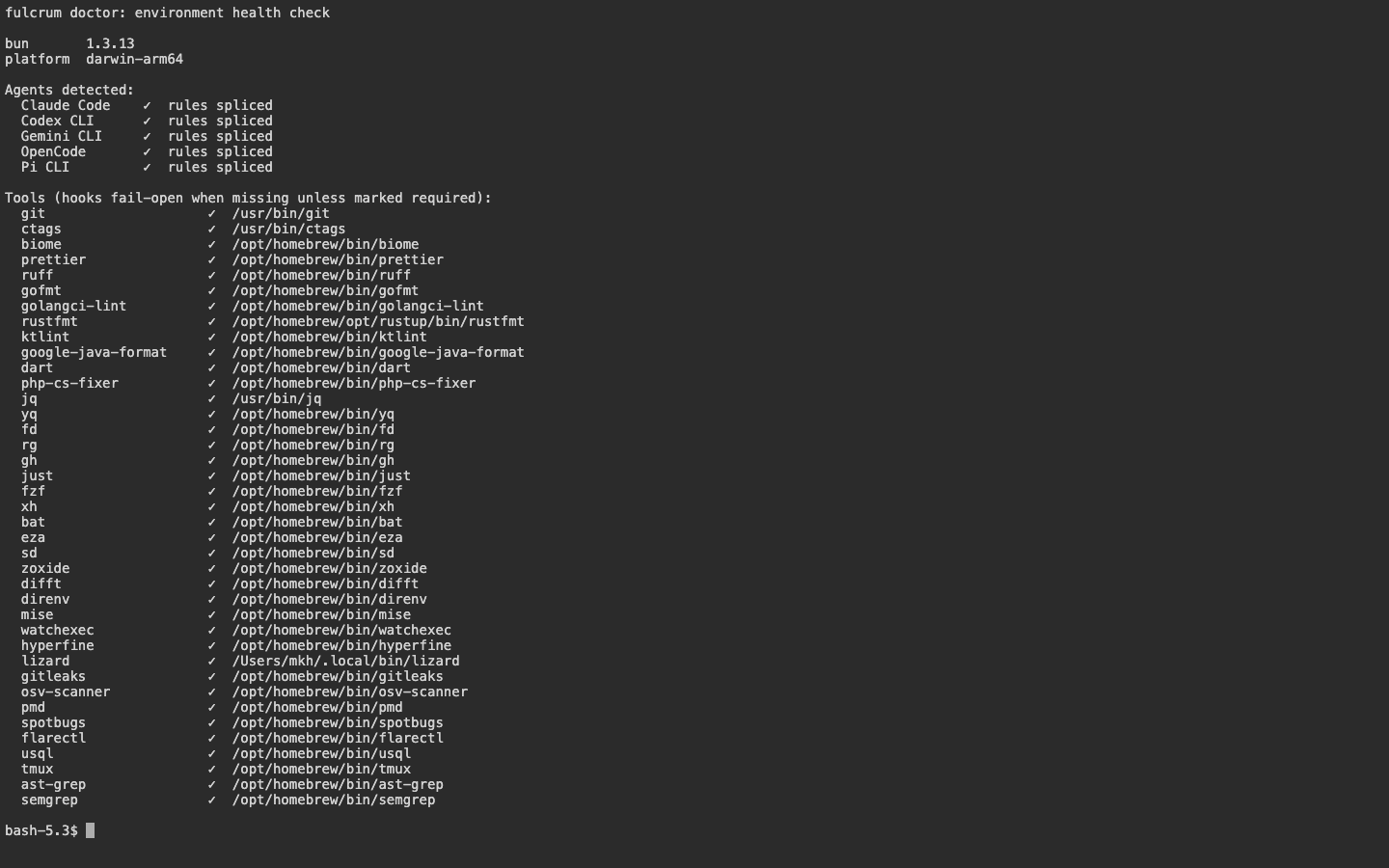 |
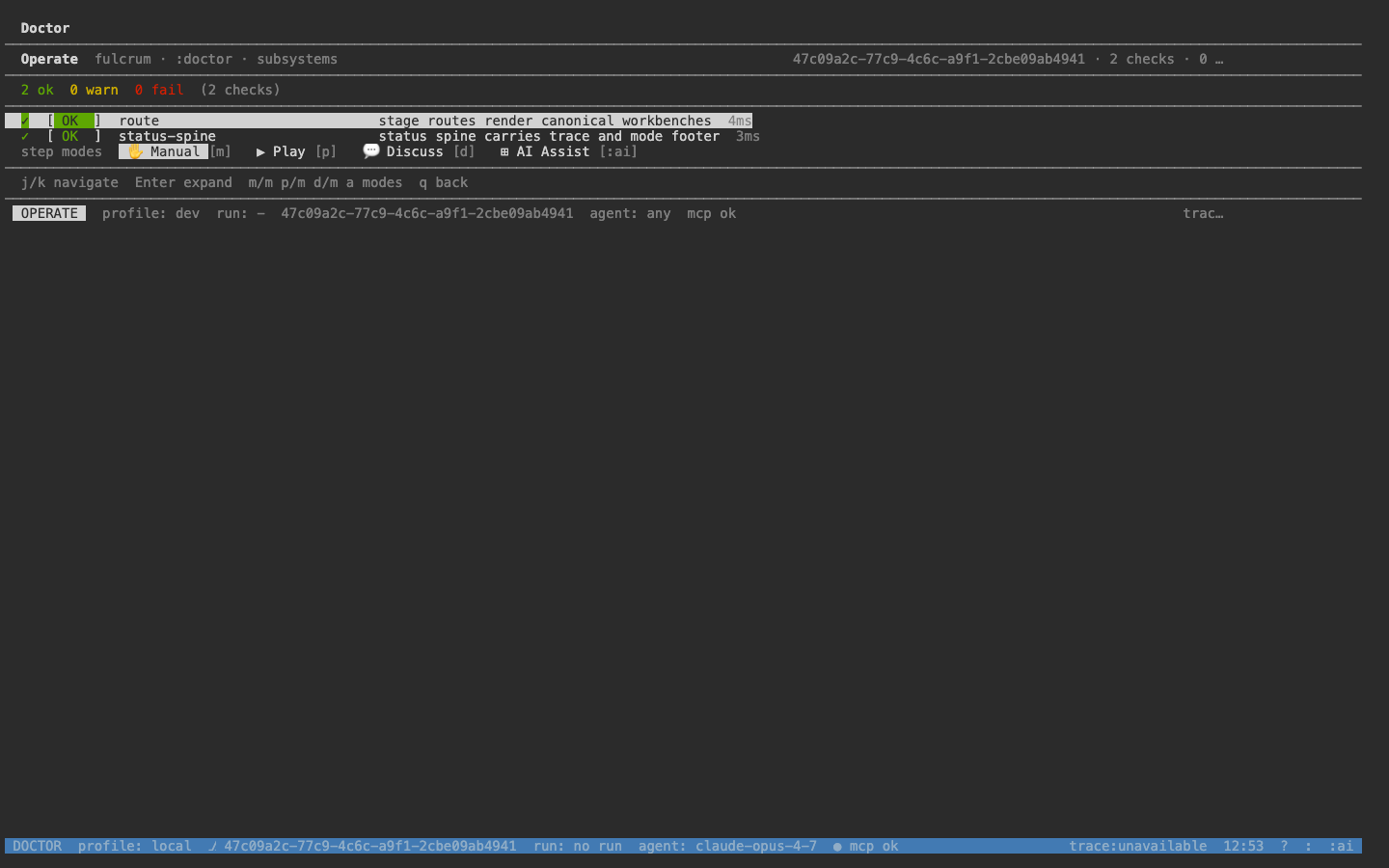 |
The Operate stage is identical across surfaces — same doctor, same MCP inventory, same plugin registry:
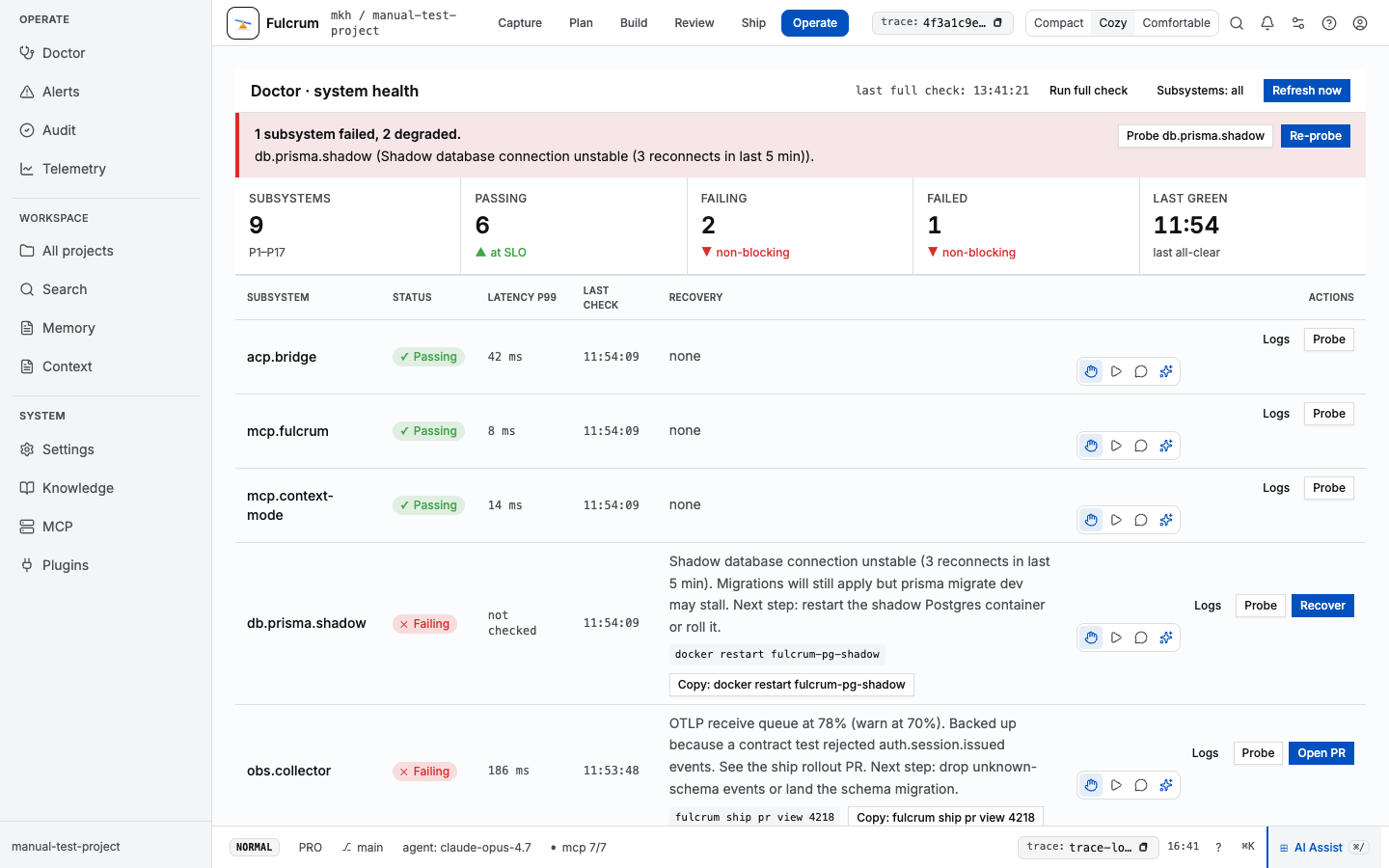
Full per-surface guides + every screen captured against live data live in
docs/manuals/.
Tasks, Boards, and the Build Graph
The work spine — what your team is doing, who's doing it, and what's blocked.
Workspace kanban — /boards
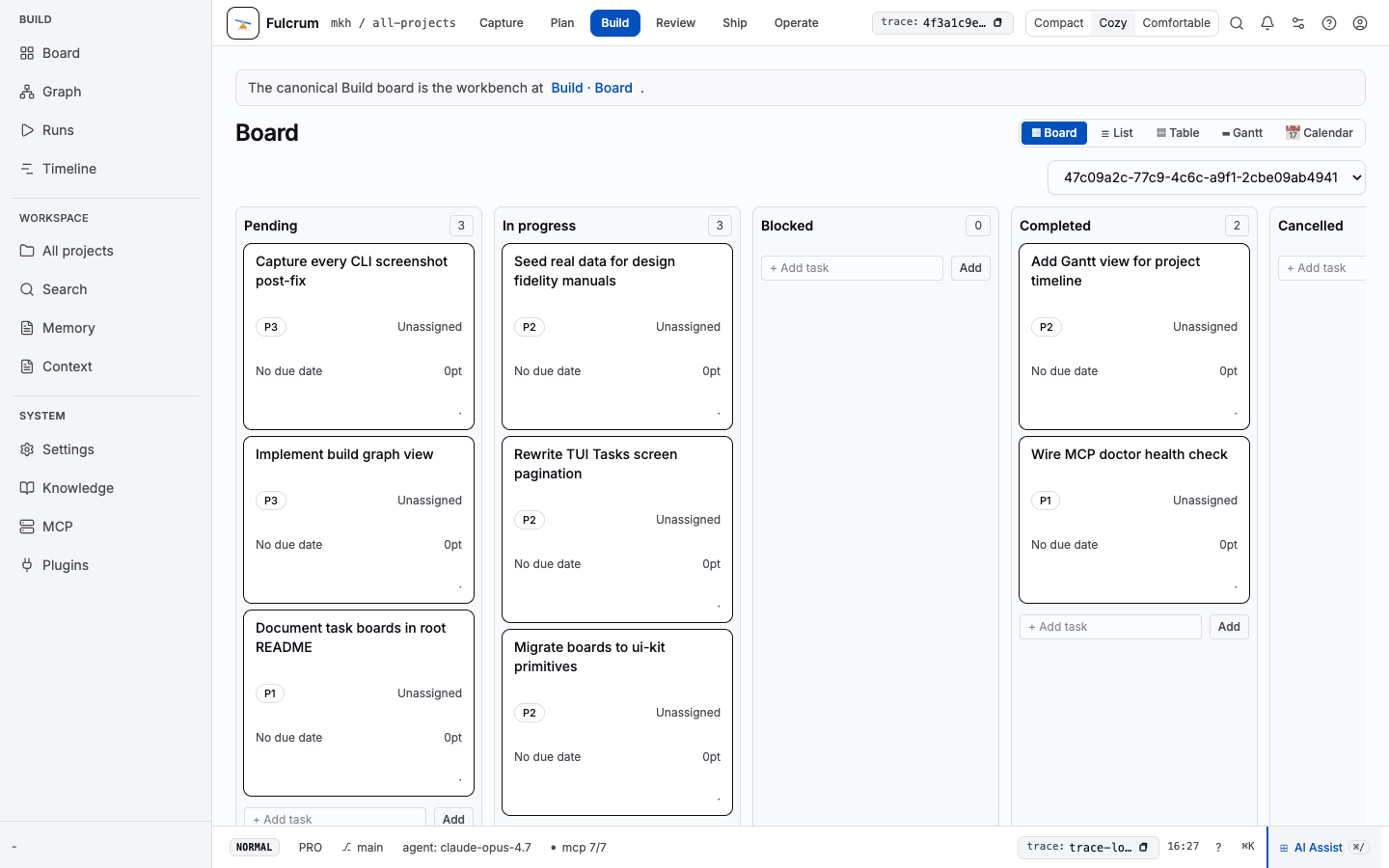
Five-column board over canonical statuses (pending, in_progress, blocked, completed, cancelled) with every task in the workspace. Tabs swap into List, Table, Gantt, or Calendar views without leaving the page. New tasks are created inline per column.
Project board — /projects/<slug>/board
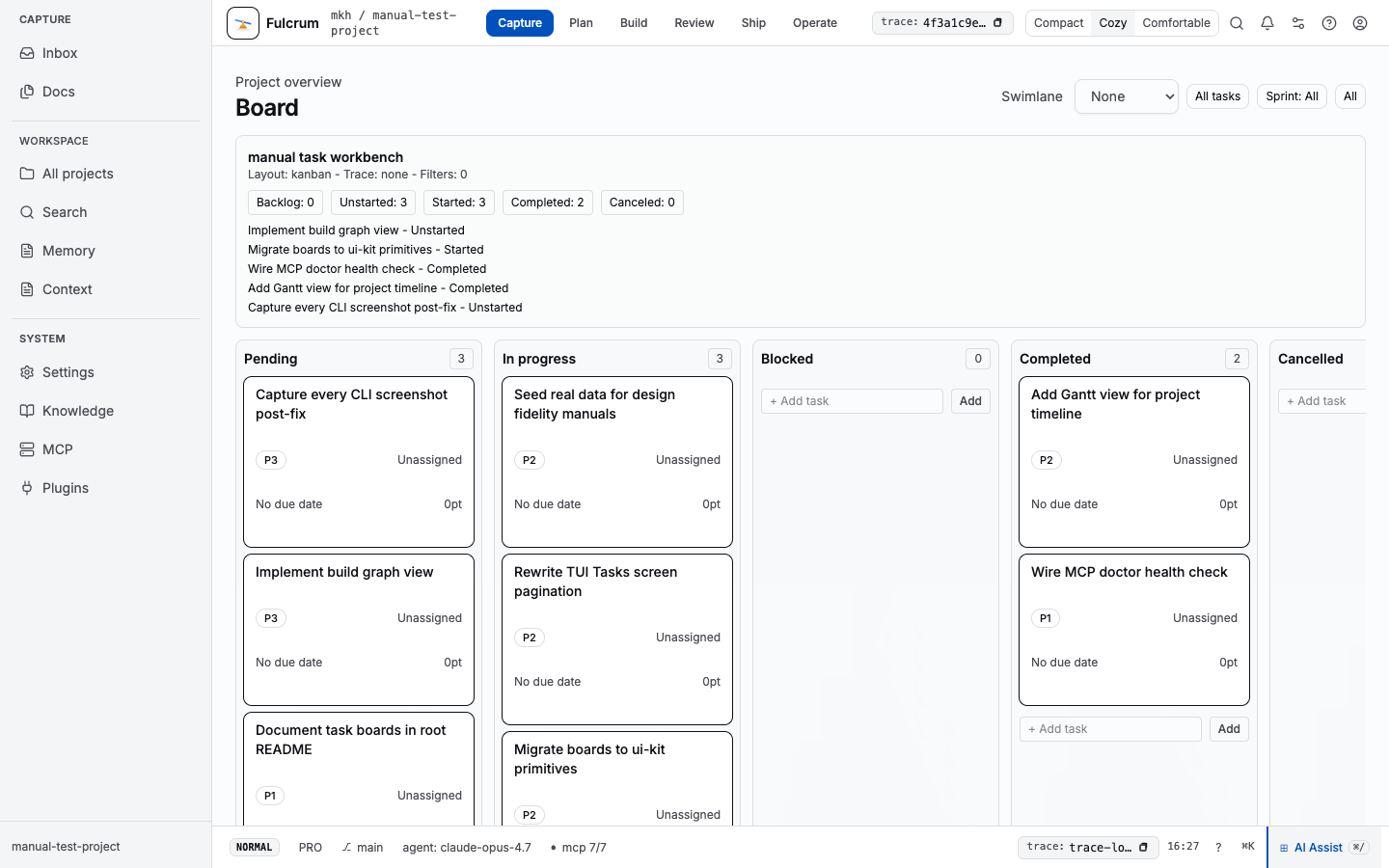
Same kanban, scoped to one project. The "manual task workbench" header summarizes Backlog / Unstarted / Started / Completed / Canceled so a PM can read status at a glance before drilling into cards.
Build dependency graph — /build-graph
Sugiyama-layered DAG of the running build. Nodes color-code by lifecycle (queued, running, awaiting, blocked, completed), edges curve along the running chain, and the selected node opens an info card with Open run + Open task actions.
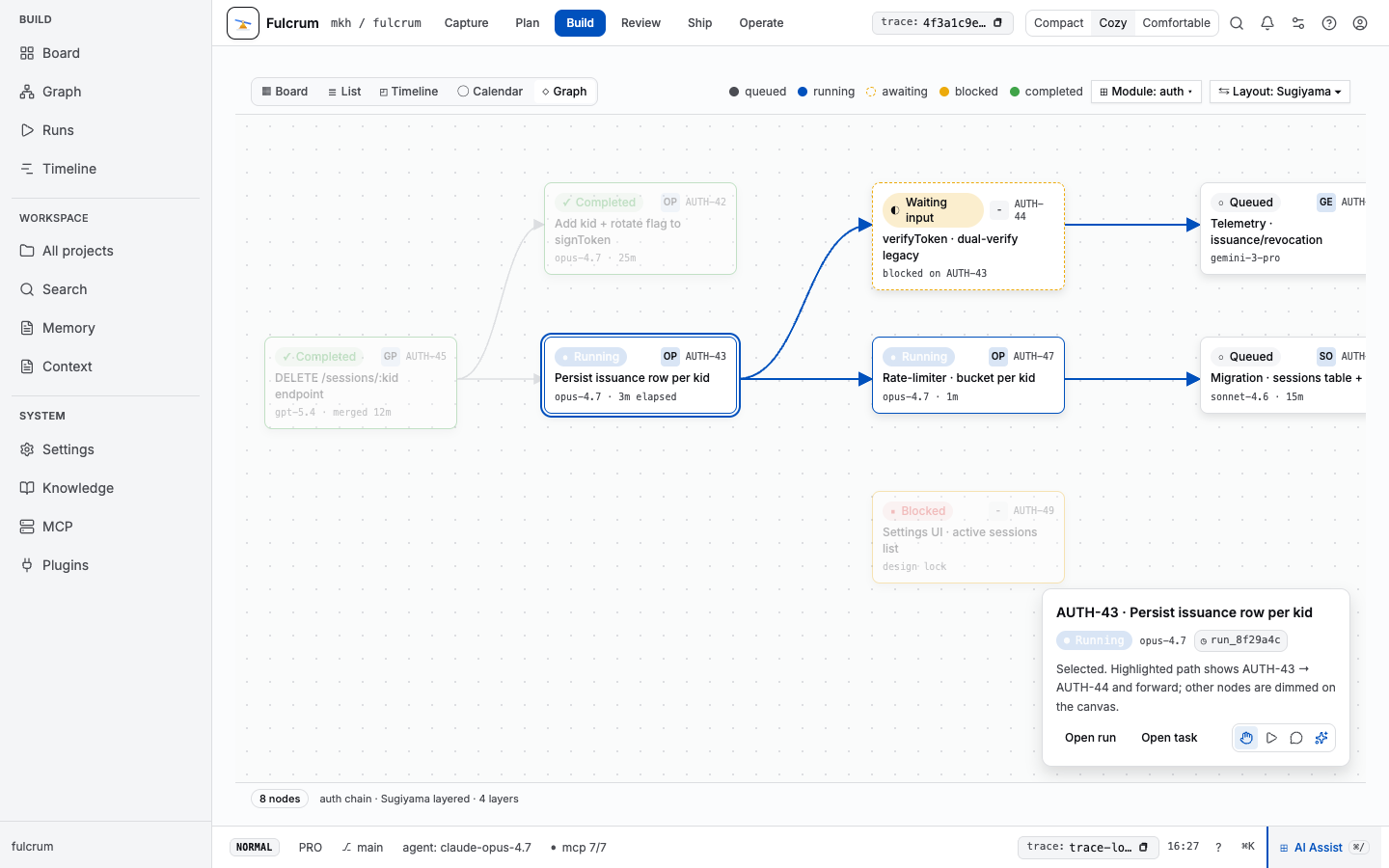
The same data drives the CLI (fulcrum tasks list --json, fulcrum runs graph --json) and the TUI (Build · Graph chord), so a human and an agent see identical state.
Plan → Review → Ship
Every stage shares the same vocabulary (status badges, ModeRow per step, trace badge in the topbar) so the UI tells the same story across the workflow:
Plan — /planning
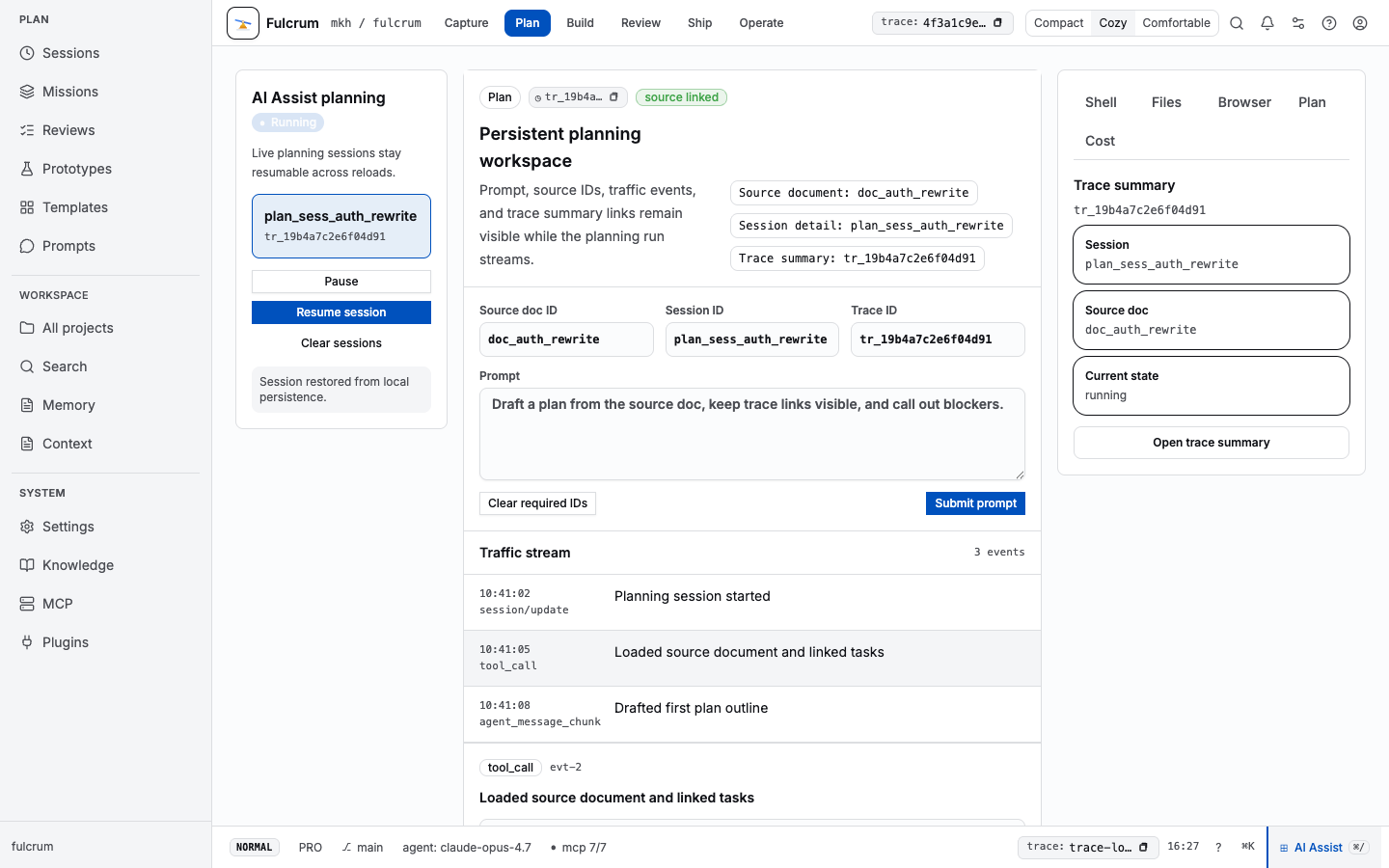
The Plan stage owns AI Assist sessions, traffic streams, and the persistent planning workspace. Sessions list left, planning workspace centre, source-doc + trace-summary on the right.
Review — /review
Code, QA, E2E, and Final QA review queues with diff + comments tripane.
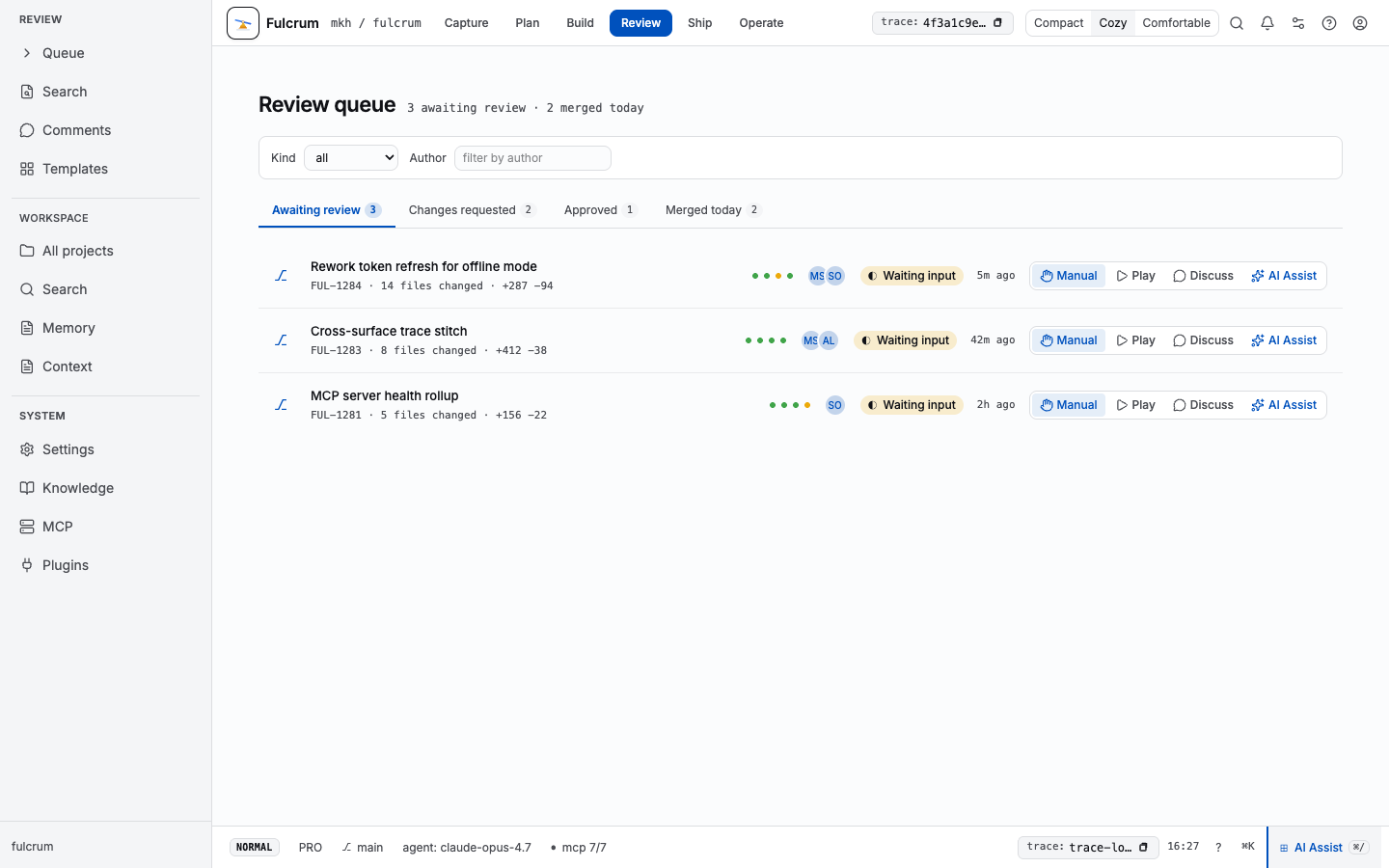
Ship — /ship
Release cuts, archive timeline, artifact bundle download — same data as fulcrum ship list --json.
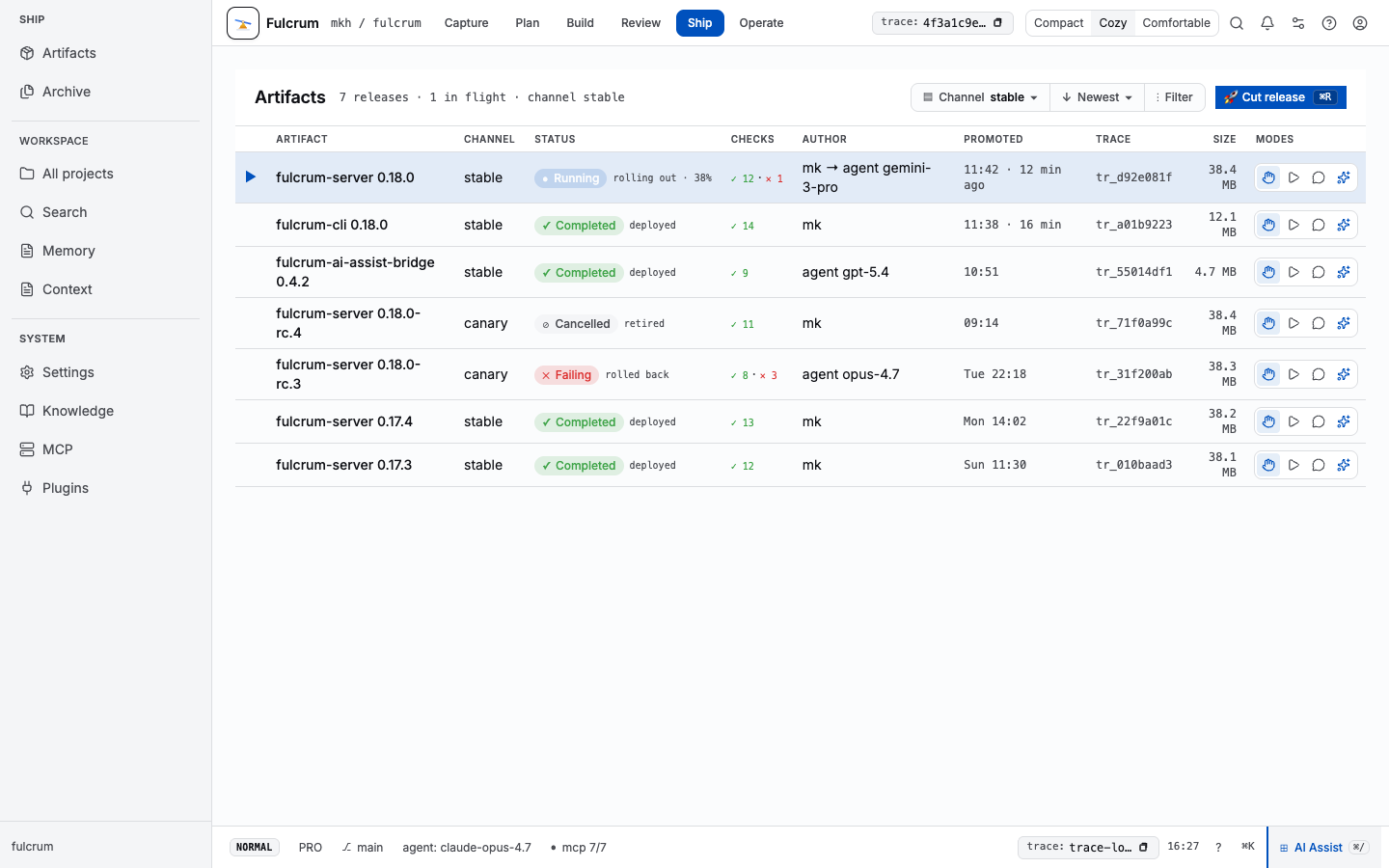
Operate — /operate
Doctor system health (subsystems, latency, error rate), MCP inventory, plugins, alerts, telemetry. Mirrors fulcrum doctor.
How it Works
            ┌─────────────────────────────────────────────────┐
            │             NestJS public API @ :3000           │
            │ /api/v1/*  +  tRPC  +  Swagger  +  agent runs   │
            └─────────────┬───────────────┬───────────────────┘
                          │               │
        ┌─────────────────┴──┐         ┌──┴────────────────────┐
        │ SvelteKit web :5173 │         │  CLI binary  +  TUI   │
        │ (no in-proc DB)    │         │ (HTTP only, no DB)    │
        └─────────────────────┘         └───────────────────────┘
                          │               │
                          ▼               ▼
            ┌──────────────────────────────────────────────────┐
            │   PGlite  ⟷  TypeORM  ⟷  fulcrum_* entity tables  │
            │   (swap to Postgres with FULCRUM_DATABASE_URL)   │
            └──────────────────────────────────────────────────┘
                          │
                          ▼
            ┌──────────────────────────────────────────────────┐
            │ Sandcastle runtime — isolated worktree + sandbox │
            │   (Claude Code, Codex, Gemini, OpenCode, Pi …)   │
            └──────────────────────────────────────────────────┘
What you get out of the box
| Pillar | What it does | Surfaces |
|---|---|---|
| Foundation | Auth, orgs, feature flags, migrations | Web · CLI |
| Symphony orchestration | Agent dispatch, run lifecycle, retry/stall recovery | Web · CLI · TUI |
| Sandcastle agent runs | Sandboxed execution, transcript capture, artifact harvest | CLI · TUI |
| Inference sidecar | Embedded models, Ollama / LM Studio backends, embeddings | CLI · Web |
| Routing & skills | Rules engine, skill marketplace, auto-assign | Web · CLI · TUI |
| Tasks & sprints | Kanban, sprints, burndown, custom fields | Web · CLI · TUI |
| Docs & collab | TipTap editor, versioning, comments, templates | Web · TUI |
| Memory & context | Heuristic extraction, BM25 retrieval, context assembly | CLI · Web |
| Repos & git | Repository supervision, file browser, commit log | Web · CLI · TUI |
| Artifacts | Run artifact storage, dedup, lifecycle | Web · CLI |
| Search | Full-text search, facets, saved searches | Web · CLI · TUI |
| Notifications | Rules engine, inbox, audit log, webhooks | Web · CLI · TUI |
| Public API | REST /api/v1/* + tRPC, OpenAPI 3.1 schema |
API |
| Cross-cutting | Themes, backups, imports/exports, telemetry, secrets | Web · CLI · TUI |
All "online" features ship but stay disabled until you opt in via
FULCRUM_FEATURES=feature-a,feature-b. The web prod build defaults to off;
local dev defaults public-api on so you can drive the stack without flags.
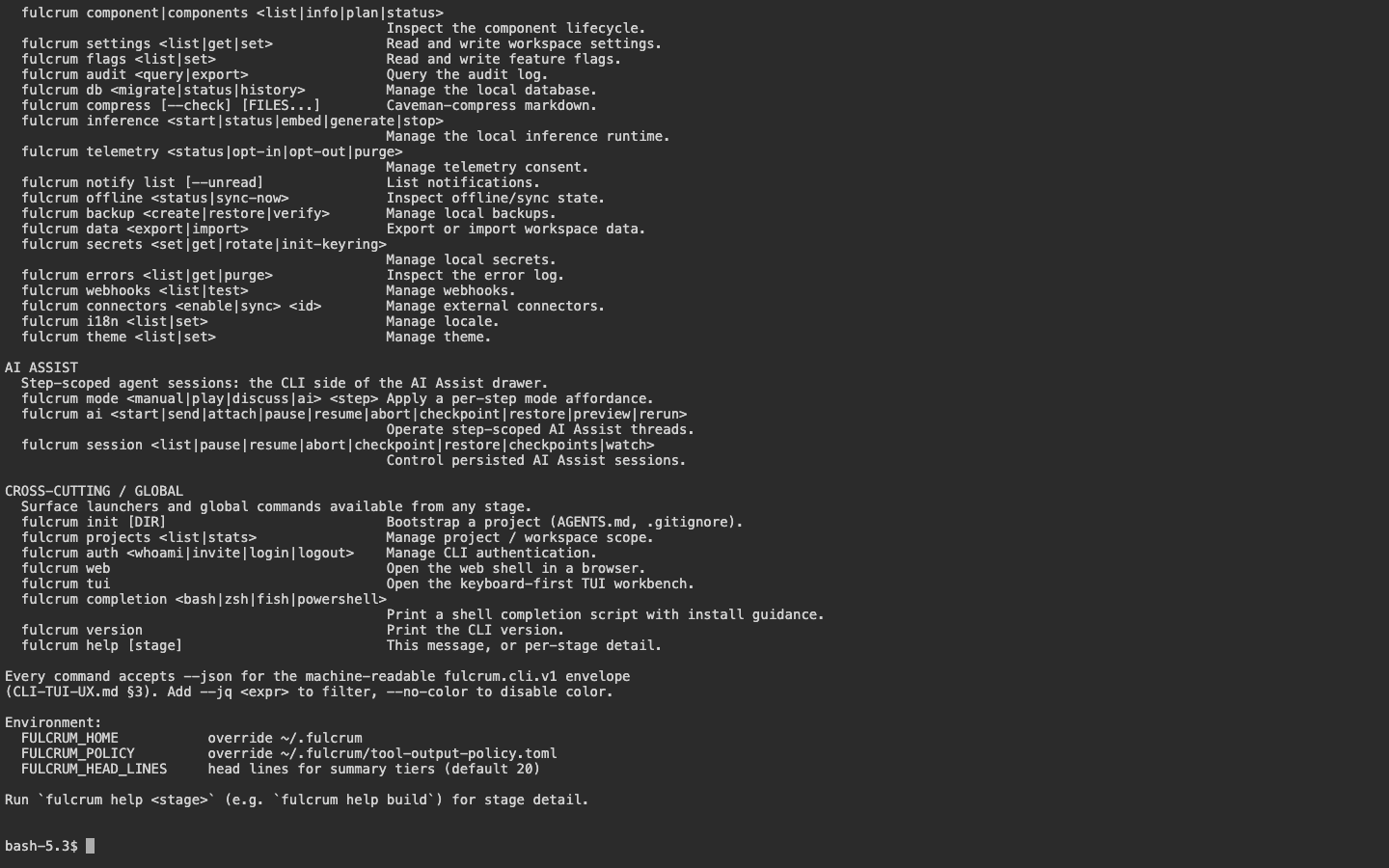
CLI in 10 seconds
fulcrum init                          # bootstrap a project (AGENTS.md, CLAUDE.md, .gitignore)
fulcrum install --profile minimal     # splice rules + hooks + skills into every detected agent
fulcrum doctor --json | jq            # canonical envelope: pipe into CI
fulcrum hooks list                    # see registered hook recipes
fulcrum skills sync                   # mirror authored skills to every agent
fulcrum compress --check              # CI gate: caveman compression up to date
Every subcommand has --help. The CLI emits a fulcrum.cli.v1 JSON envelope
under --json for machine consumers.
Status
- alpha — wire-up complete across all 13 service domains; APIs settling.
- 1,500+ tests pass on
dev/v1.0(typecheck 0, architecture 208/0, ui-kit 90/0, web 1,525/0). - The web is a verified pure invocation layer —
tests/architecture/enforces it. - Active areas: sprint↔task entity unification, TUI screen coverage, additional MCP servers.
See docs/manuals/findings.md for the most recent
manual-test pass and a transparent ledger of bugs found + fixed + open.
Acknowledgements
Fulcrum stands on shoulders. Two projects in particular were so directly useful they're hard-coded into the stack:
🏰 Sandcastle — by @mattpocock
@ai-hero/sandcastle powers every
agent run in Fulcrum. It hands us:
- Isolated worktree + sandbox per run (Docker / Podman / Vercel / custom).
- Provider abstraction across Claude Code, Codex, Gemini, OpenCode, Pi.
- Branch-strategy management so agents never touch your live tree.
You can see it live in services/execution-orchestration/infrastructure/agent-runtime/sandbox-runner.ts — runAgent + resolveProvider + sandboxProviderDoctorChecks are all Sandcastle bindings. The fulcrum doctor sandbox check returns Sandcastle's provider availability + trust-boundary warning verbatim. Pin: @ai-hero/sandcastle@0.5.6 (tests/execution-orchestration/agent-runtime/sandcastle-deps.test.ts keeps it locked).
📚 Skills — by @mattpocock
The mattpocock/skills repository is
the upstream pattern Fulcrum's fulcrum skills upstream mirrors. Authored
skills follow the same SKILL.md frontmatter + body shape; the same lint
rules apply. Without Matt's work on what a skill IS, this layer would not
exist.
Thank you, Matt — both gifts are foundational.
🎼 Symphony — by OpenAI
Fulcrum implements OpenAI's Symphony
orchestration spec — the work-board → autonomous-run lifecycle, evidence
contracts, retry/stall recovery, PR-landing semantics. fulcrum doctor --subsystem symphony validates conformance.
Thanks to the OpenAI contributors driving Symphony forward — including @frantic-openai, @hintz-openai, @danial-openai, @kevinw-openai, and @mstrautmann-oai. Your spec made this build dramatically less ambiguous.
Stack credits
NestJS · SvelteKit · OpenTUI · TypeORM · PGlite · Bun · ui-kit (shadcn-svelte vocabulary, OKLCH tokens) · TipTap · Better-Auth · Effect.
License
MIT. Use it. Fork it. Ship it.