
discourse-descentConsensus-based multi-agent debate as a native opencode plugin: heterogeneous debater sessions argue a question over annealed rounds; a coordinator judges convergence and synthesizes an answer; optimizer-analogy steering strategies and a transformers.js R
1
39
近 7 天 10
30.5
生态多维模型
1 个月前
2026-07-11
快速安装与配置
opencode.json写入当前项目的 opencode.json,只对这个仓库生效。
opencode.json
{
  "$schema": "https://opencode.ai/config.json",
  "plugin": ["discourse-descent@0.1.1"]
}
写入 ~/.config/opencode/opencode.json,对所有项目生效。
~/.config/opencode/opencode.json
{
  "$schema": "https://opencode.ai/config.json",
  "plugin": ["discourse-descent@0.1.1"]
}
若你要在本地改造这个插件,先装到项目里再从本地路径引用。
shell
pnpm add -D discourse-descentopencode 启动时会通过内嵌运行时自动加载 npm 依赖并缓存至本地目录,无需手动在全局环境执行安装。
A consensus-based multi-agent debate engine, shipped as a native opencode plugin. Debate as gradient descent toward consensus.
Make several cheap LLMs argue a question to consensus — and get a materially better answer than any one of them could give alone.
discourse-descent is a native opencode plugin. It runs a panel of LLM
"debaters" — each backed by a different model — through several temperature-annealed rounds. A
coordinator judges convergence each round and synthesizes one final answer. It's a drop-in tool:
/debate <question>.
The result
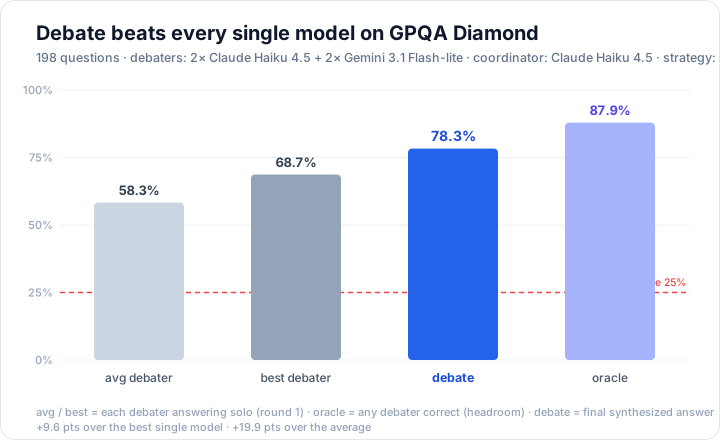
On GPQA Diamond (198 graduate-level, "Google-proof" science questions) a panel of four small, cheap models — 2× Claude Haiku 4.5, 2× Gemini 3.1 Flash-lite, with a Claude Haiku 4.5 coordinator — scored:
| accuracy | vs debate | |
|---|---|---|
| Debate (final answer) | 78.3% | — |
| Best single debater (solo) | 68.7% | +9.6 pts |
| Average single debater (solo) | 58.3% | +19.9 pts |
| Oracle — any debater was right | 87.9% | headroom left on the table |
| Random chance | 25% | — |
For context, the GPQA paper reports PhD-domain experts at 65% and a GPT-4 baseline at 39% on the (easier) main set. Four small models debating cleared the paper's expert bar on the harder Diamond subset — while individually averaging 58%.
The lift is the whole point: debate turns a bag of mediocre-but-diverse answers into one good one. The 87.9% oracle says the panel usually contains the right answer — better synthesis captures more of it.
These numbers were measured on the full
Diamond set with the sgd strategy; raw data + full provenance in
docs/benchmarks/gpqa_diamond/. One caveat: the human/GPT-4 baselines are
from the GPQA paper's easier main set, so cross-comparisons are indicative, not head-to-head.
The problem it solves
A single LLM call on a hard reasoning question is a fancy coin flip you can't inspect: one sample, one
chain of thought, no second opinion. Sampling the same model again mostly repeats its blind spots.
discourse-descent instead runs different models with different personas, lets them see and
rebut each other, and anneals from "argue hard" to "find common ground" — so mistakes get challenged
and the panel converges on what survives scrutiny. You trade tokens for accuracy on the questions
where accuracy is worth it.
How it works
Each round:
- Debate — every debater (any roster, ≥ 2) answers in parallel, seeing the other debaters' previous-round positions inline in its prompt.
- Anneal — a temperature ramps from
1.0(round 1,FIRM) down to0.0(final round,CONSENSUS-SEEKING). Early rounds argue; late rounds converge. - Judge — the coordinator reads all positions and returns a structured convergence judgment.
- Stop — the debate ends early only when it has converged and agreement clears the
threshold; otherwise it runs to
maxRounds. - Synthesize — the coordinator produces the single final answer.
Relevant past debates are retrieved from a local RAG memory (transformers.js embeddings) and injected as context, so the panel can build on prior conclusions.
Install
Published on npm as discourse-descent.
OpenCode plugin
Add the package name to your opencode.json. OpenCode installs npm plugins from the registry
automatically at startup — no manual npm install in your project:
{
  "$schema": "https://opencode.ai/config.json",
  "plugin": ["discourse-descent"],
  "command": {
    "debate": {
      "template": "Use the `debate` tool to run a consensus debate on: $ARGUMENTS",
      "description": "Run a multi-agent consensus debate"
    }
  }
}
Authenticate the providers your roster uses (opencode auth login).
Local development
To work on this repo instead of the published package, point plugin at the checkout after
npm run build:
{
  "plugin": ["./"]
}
Programmatic use
To import runDebate, createOpencodeDebateClient, strategies, etc. outside the plugin entrypoint:
npm install discourse-descent @opencode-ai/plugin @opencode-ai/sdk
(@opencode-ai/plugin and @opencode-ai/sdk are peer dependencies — install them in your app.)
Use
In the opencode TUI:
/debate Should we adopt a monorepo?
or call the tool directly from an agent:
debate({ question, scope?, maxRounds?, strategy?, config? })
It streams per-round progress as toasts + logs and returns a summary plus the full DebateResult
JSON (answer, finalValue, confidence, convergence metrics, loss curve, token usage).
Demo
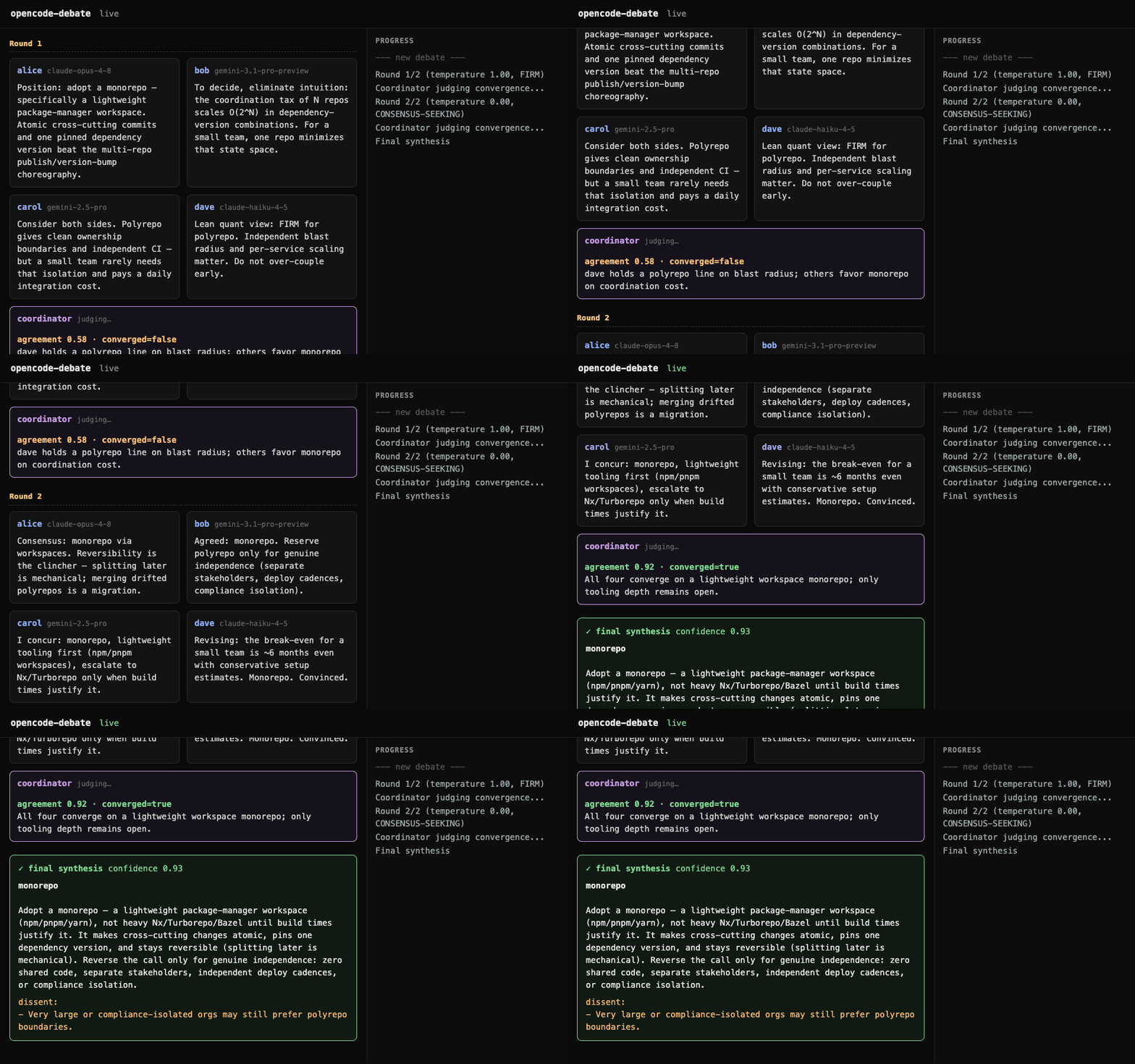
An opt-in live dashboard over Server-Sent Events — one card per debater per
round (full positions), the coordinator's per-round verdict, and the final synthesis. Run any
debate with DEBATE_DASHBOARD=1 set and open the URL from the toast:
DEBATE_DASHBOARD=1 DEBATE_DASHBOARD_PORT=4123 opencode # then /debate …, open http://127.0.0.1:4123
Cost & when to use
Debate is deliberately expensive: it's several models × several rounds. On the GPQA run above, a single question cost ~0.6M–1.2M tokens (cheap models, so still cents each). Reach for it on hard, high-value questions — thorny design calls, science/math reasoning, ambiguous trade-offs — not on things one fast call already nails.
Configure
Debaters, models, and run params are a Zod-validated DebateSettings, loadable from JSON so you can
run any roster (any names, any count ≥ 2) without editing code. Precedence:
explicit config arg → DEBATE_CONFIG env var → built-in defaults. See
debate_config.example.json.
A model is { providerID, modelID } — resolved by opencode against whatever providers you've
authenticated. Each debater may add an optional persona and a tools allowlist (defaults to a
read-only set: read/grep/glob/list/webfetch). Distinct models + distinct personas are what
make positions diverge — and divergence is what the debate exploits.
Tools drive accuracy on quantitative tasks. The default roster is read-only. The GPQA reference run above let debaters execute code, which likely accounts for much of its edge on numeric questions. If you're benchmarking math/science, add a code/bash tool to the debaters'
toolsallowlist — at the cost of running model-written code. Seedebate_config.code.example.jsonfor a ready-made code-enabled roster (bash: true, write/edit/patch still off).
Steering strategies (the optimizer analogy)
The debate loop is loosely gradient descent toward consensus, so a strategy is the optimizer:
position embeddings are the parameters, group-centroid drift is the gradient, the temperature anneal
is the learning rate. A strategy carries state across rounds and injects per-debater steering
directives into the next prompt. Available strategy.kind values:
| kind | behavior |
|---|---|
sgd |
stateless — coordinator only judges + synthesizes (default) |
momentum |
EMA of group consensus drift; nudges each debater with/against the trend |
rmsprop |
per-debater EMA of drift magnitude; damps thrashers, pushes the stuck |
adam |
momentum + rmsprop combined |
adagrad |
per-debater cumulative drift; a deliberate force-a-decision mode |
The embedding strategies first steer in round 3 (a drift needs two snapshots), so use
maxRounds >= 4 to exercise them. Full design: docs/coordinator_strategies.md.
Benchmark
src/bench.ts runs each strategy over a real benchmark and compares them on convergence,
correctness, and token usage. It boots an in-process opencode server, calls runDebate
directly for a typed DebateResult, and grades against ground truth pulled live from the HuggingFace
datasets-server REST API (no HF datasets library needed). Grading is deterministic extraction
first, falling back to an LLM judge only when extraction is ambiguous (--no-judge to disable).
npm run bench -- --strategies sgd,momentum --n 5 --max-rounds 4
npm run bench -- --dataset cais/mmlu --dataset-config all --n 10 --no-judge
# GPQA is gated on the Hub: export HF_TOKEN and accept the dataset terms first.
HF_TOKEN=hf_... npm run bench -- --dataset Idavidrein/gpqa --dataset-config gpqa_diamond --split train --n 5 \
  --debate-config docs/benchmarks/gpqa_diamond/roster.json \
  --strategies sgd,momentum,adam,rmsprop
Strategies, measured
The four steering strategies on the full GPQA Diamond run behaved as follows (see provenance):
| strategy | accuracy | mean rounds | tokens / question | converged |
|---|---|---|---|---|
momentum |
82.3% | 2.1 | 1.08M | 97% |
rmsprop |
79.3% | 2.0 | 0.48M | 99% |
sgd |
78.3% | 2.0 | 0.81M | 98% |
adam |
76.8% | 2.1 | 1.13M | 99% |
On this run momentum edged out the others on accuracy; rmsprop was a close second at roughly
half the token cost. Debates still averaged only ~2 rounds, so several hypotheses could explain the
spread, none yet verified:
- H1 — too few rounds. The embedding strategies first steer in round 3, but debates here averaged only ~2 rounds — so on most questions they never actually activated.
- H2 — untuned Adam. Its hyperparameters (β / β2 / learning-rate analogue) may not suit this task.
- H3 — task too easy. The questions may not be hard enough to separate the strategies.
Treat the optimizer analogy as an experiment to run on your task, not a ranking that transfers — the win came from the debate itself, and steering is a second-order knob on top of it.
Flags: --strategies, --n, --dataset / --dataset-config / --split, --offset, --seed
(GPQA option-shuffle), --max-rounds (use >= 4), --workers (concurrent debates), --no-judge,
--append, --skip-completed (resume: skip successful (strategy, item) pairs already in
runs.csv; implies --append; error rows are retried), --attach <url> (reuse a running
opencode serve), --debate-config, --out. Writes a
per-strategy table, a debate-lift table, and runs.csv / summary.csv.
Architecture
/debate (TUI)  ->  debate tool (plugin.ts)  ->  runDebate(client, ...) (orchestrator.ts)
                                                    |-- per debater/round: opencode sessions (read-only tools, distinct models)
                                                    |-- strategies.ts (SGD/Momentum/RMSprop/Adam/Adagrad)
                                                    |-- memory.ts (transformers.js + brute-force cosine store)
                                                    '-- coordinator session -> structured JSON judgment + synthesis
client.ts— theDebateClientinterface (the whole engine + test suite depend only on this) and thecreateOpencodeDebateClientadapter over the real opencode SDK client.orchestrator.ts—runDebate: rounds, parallel debaters, inline position exchange, dual stop condition, persistence, token aggregation, progress.strategies.ts— the five steering strategies +buildStrategy.memory.ts— transformers.js embeddings (Xenova/all-MiniLM-L6-v2) + a brute-force cosine index persisted to JSON per scope. Injectable embedder so tests never download a model.prompts.ts— temperature annealing, the shared temperature→mode helper, prompt builders.schemas.ts— Zod schemas + JSON Schema exports for the coordinator's structured output.settings.ts— the Zod config.
A note on structured output
The coordinator targets opencode's native format: { type: "json_schema" } structured output. As of
the current SDK type surface that field may be absent, so the coordinator doesn't depend on it: it
requests JSON, parses + Zod-validates + retries, and also passes format through in case a build
supports it (a native structured output on the response is preferred over parsing). The exact SDK
call shapes live only in client.ts — confirm them against a running server's /doc and adjust that
one file if they differ.
Develop
npm install
npm run test        # vitest — fully offline (mocked client, injected embedder)
npm run typecheck   # tsc --noEmit
npm run build       # tsup -> dist/
npm run check       # typecheck + test + build
Release
Bump version in package.json, merge to main, then tag:
git tag v0.1.0 && git push origin v0.1.0
CI runs tests on the tag and publishes discourse-descent
to npm when the tag matches package.json (e.g. tag v0.1.0 → version 0.1.0). Publishing uses
npm trusted publishing (OIDC from GitHub Actions — no
long-lived NPM_TOKEN).