
Agents Monitor
OpenCode TUI plugin — live sub-agent status in the sidebar
2
+1 in 30 days
255
54 in 7 days
40.6
Multi-signal model
11 days ago
2026-09-24
Install and configure
opencode.jsonWrites to this project's opencode.json — applies to this repository only.
opencode.json
{
  "$schema": "https://opencode.ai/config.json",
  "plugin": ["opencode-agents-monitor@0.1.2"]
}
Writes to ~/.config/opencode/opencode.json — applies to every project.
~/.config/opencode/opencode.json
{
  "$schema": "https://opencode.ai/config.json",
  "plugin": ["opencode-agents-monitor@0.1.2"]
}
If you want to modify the plugin locally, install it into the project and reference the local path.
shell
pnpm add -D opencode-agents-monitorOpenCode loads npm dependencies through its embedded runtime on startup and caches them locally — no manual global install needed.

Keep every OpenCode sub-agent in sight.


English | 中文
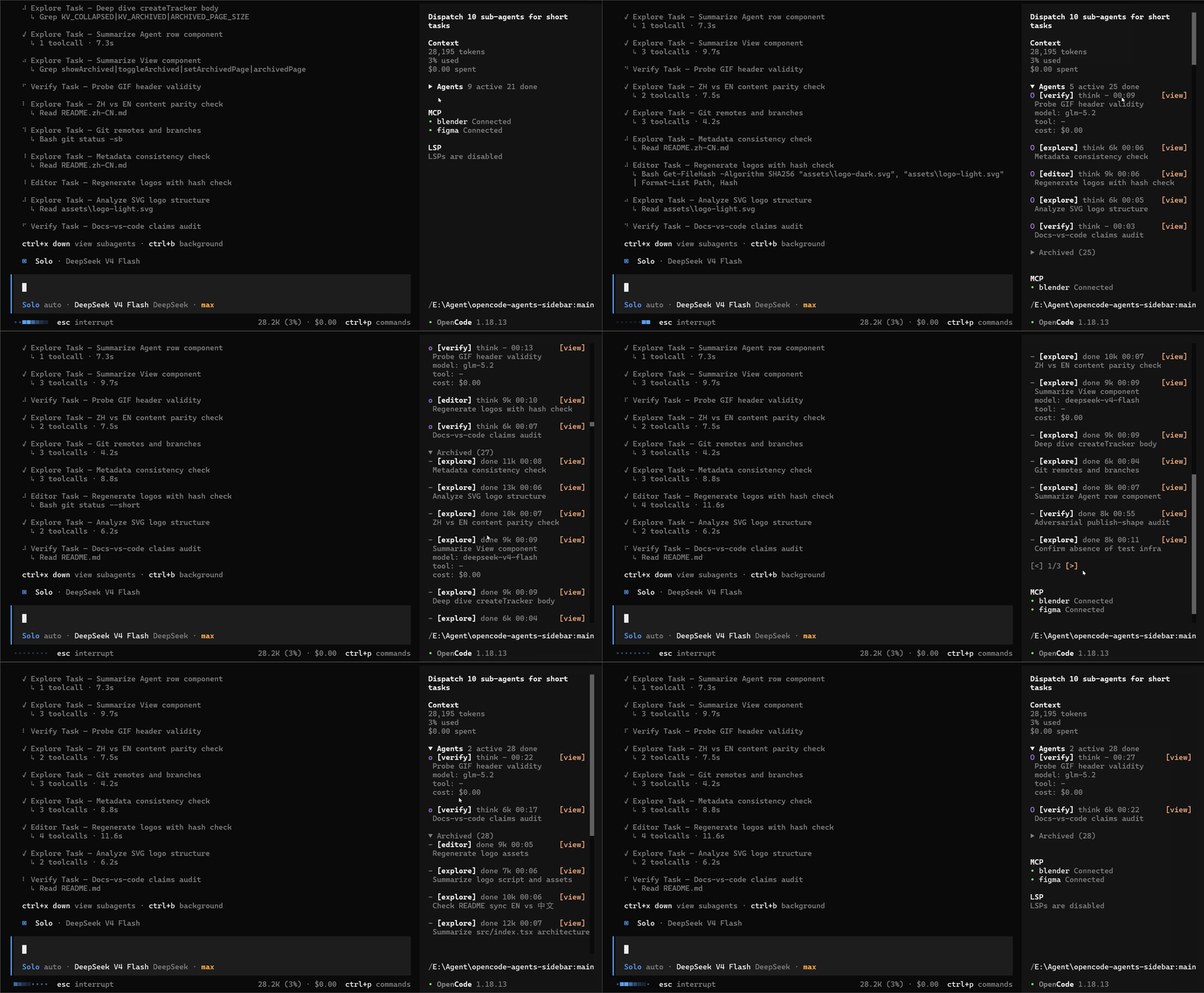
An OpenCode TUI plugin that brings live sub-agent progress straight into the session sidebar. See which agents are still working, what each one is doing, and the elapsed time, context, and cost for each, all without leaving your main session.
Expand an agent for its model, current tool, and cost. When you need the full story, open the child session directly from the sidebar.
[!IMPORTANT] OpenCode v1 and v2 use incompatible plugin APIs. A plugin built for one cannot run on the other. This project maintains two release lines, and both are supported long-term — the v1 line keeps receiving bug fixes:
Plugin version OpenCode version Install Configuration 0.1.2(this branch,main)v1 ( 1.18.0+)opencode plugin opencode-agents-monitor@0.1.2tui.json→"plugin"(global or project)0.2.x(feat/v2branch; available on npm under thebetatag)v2 ( 2.0.0+)opencode plugin add opencode-agents-monitor@beta(the stable0.2.0release will move tolatest)Global ~/.config/opencode/cli.json→"plugins"
- Running OpenCode v1? You are in the right place — see Installation below.
- Running OpenCode v2? Use the
0.2.xline from thefeat/v2branch.
Why use it?
Once a session fans out across several tasks, it becomes hard to tell what is still moving and what has already finished. The widget keeps that picture visible: active work updates in real time, completed agents move out of the way, and earlier child sessions reappear when the TUI starts.
What you get
- Live progress at a glance: distinguish
thinking,tool,retry,done, andidlestates as they change - The current tool, while it runs: see a concise call such as
bash npm testbefore it finishes - Useful numbers, not noise: context, elapsed time, model, and cost for each agent
- A tidy long-running session: completed agents are sorted into the paginated
Archived (n)section automatically - Details on demand: keep rows compact, expand the ones you care about, or use
[view]to open the full child session; pressupto return - History after a restart: context and elapsed time for earlier agents are restored lazily from the API
Installation
This branch is the OpenCode v1 line and requires OpenCode 1.18.0 or later. Pin 0.1.2 explicitly so a future v2 release on the latest dist-tag is never installed into a v1 host:
opencode plugin opencode-agents-monitor@0.1.2
Once the opencode-v1 dist-tag is published, opencode-agents-monitor@opencode-v1 resolves to this line and can replace the pinned version above.
Restart OpenCode after installation. The widget appears in the session sidebar; press ctrl+x, then b if the sidebar is hidden.
Manual installation
Add to ~/.config/opencode/tui.json (global) or .opencode/tui.json (project):
{
  "plugin": ["opencode-agents-monitor@0.1.2"]
}
On OpenCode v2, use the 0.2.x line from the feat/v2 branch instead.
Usage
| Action | Result |
|---|---|
Click the Agents header |
Collapse or expand the entire widget (persists) |
| Click an agent row | Show or hide its model, current tool, and cost |
Click [view] |
Open the agent's complete child session |
Click Archived (n) |
Show or hide completed agents (persists) |
Click [<] / [>] |
Move through archived pages |
Status markers breathe while an agent is active; ! means retrying, and - means idle or done.
How it works
- Uses the TUI's official
sidebar_contentslot, the same extension point as the built-in Context and Todo widgets. No host patching required. - Finds child sessions (
parentID) fromsession.created,session.updated, andsession.deletedevents, plus one initialsession.list()call. - Combines
session.statusevents (busy/retry/idle) with the shared message store to show live state and the latest tool call. - Fetches
session.messagesonce for completed agents when needed, restoring context size and elapsed time for historical sessions. - Keeps widget state outside the slot component tree, so slot re-renders do not reset your expanded and archived preferences.
Development
git clone https://github.com/Dqz00116/opencode-agents-monitor
cd opencode-agents-monitor
bun install
Reference the source from tui.json while developing locally:
{
  "plugin": ["./path/to/opencode-agents-monitor/src/index.tsx"]
}
After changing the logo source, regenerate both variants with node script/logo.mjs.
Publishing
The npm package must ship a compiled ESM entry. The host only applies its Solid JSX transform outside node_modules, so exporting raw src/index.tsx would cause the plugin to be skipped during loading.
bun install
bun run build # writes dist/index.js
Run npm publish after npm login. The source-based file-plugin setup above remains the recommended local development flow.
License
MIT
Similar plugins

Agents Sidebar
opencode-agents-sidebar
Universal OpenCode TUI sidebar for browsing provider agents and subagents

Subagents
@opencode-cockpit/subagents
See what your subagents are doing: in the sidebar, full screen, and message them

Subagent Magazine
opencode-subagent-magazine
OpenCode TUI plugin monitoring sub-agent invocation status in real time